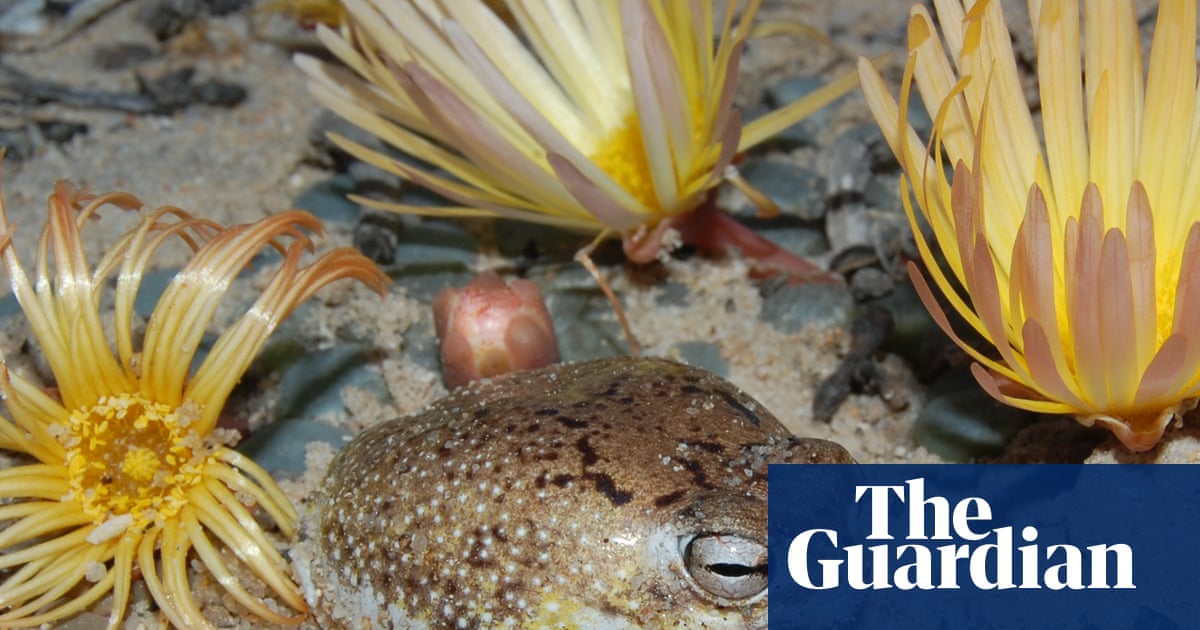
A recent update to the global Red List has cast a stark light on the increasing peril faced by Earth’s unique inhabitants, revealing that even species with the most astonishing survival adaptations are being pushed to the brink by relentless human activity. Among these, the diminutive yet incredibly resilient desert rain frog, a creature of the arid African sands, now faces an existential threat.
The Plight of the Desert Rain Frog
Known for its stout body, bulging eyes, and a rather endearing high-pitched squeak, the desert rain frog possesses an evolutionary marvel: it needs almost no standing water to survive. Unlike its aquatic cousins, this fascinating amphibian, found along the west coast of South Africa and Namibia, adeptly buries itself deep within the sand to escape the blistering sun, emerging only under the cloak of night to hunt. However, its ingenious adaptations are proving no match for the insatiable demands of industry.
Diamond mining, a lucrative but environmentally devastating endeavor, along with the unchecked expansion of energy infrastructure into its fragile habitat, has critically imperiled this distinctive frog. Compounding these threats, a viral video showcasing its unique distress call inadvertently sparked a surge in demand within the exotic pet trade, adding further pressure to its already dwindling numbers. It’s a sobering reminder that human fascination, when unchecked, can be as destructive as industrial exploitation.
This species is not alone. The International Union for Conservation of Nature (IUCN), the esteemed body behind these critical conservation updates, reported that two-thirds of hundreds of mollusc species found solely on deep-sea hydrothermal vents are also staring down extinction. These extraordinary creatures, thriving in environments where water temperatures can soar to 450C, are now threatened by the looming shadow of deep-sea mining. The exploration and extraction of sub-oceanic minerals churn up sediments, suffocating these delicate ecosystems. Experts note that many of these species have only been discovered in the last decade, yet their future is already precarious.
Conservation Successes Offer a Glimmer of Hope
While the outlook for many species appears grim, the IUCN’s latest assessment isn’t entirely devoid of positive news. Decades of concerted global species assessment have shown that dedicated conservation efforts do, in fact, work. Take the numbat, for instance. This stripy, termite-eating marsupial from Australia has made a remarkable comeback, shifting from ‘endangered’ to ‘near threatened’ on the Red List. Its resurgence is a testament to intensive protection programs against invasive feral cats and foxes, including predator-proof fencing, baiting, and successful captive breeding programs.
“Life on Earth has adapted to survive in the most hostile and unusual habitats,” remarked Dr. Grethel Aguilar, IUCN director general. “But there is a clear path out of the biodiversity crisis: nature conservation works. By protecting the astounding range of biodiversity on this planet, we can preserve a welcoming environment for humans and wildlife alike.” Indeed, a portion of deep-sea vent molluscs remain safe in marine protected areas where mining is strictly prohibited, underscoring the effectiveness of designated sanctuaries.
However, the fight is far from over. The desert rain frog, among thousands of other species, demands our immediate attention and a profound shift in our approach to resource extraction and habitat preservation. The choice is clear: continue on a path of unchecked destruction, or embrace the conservation successes as blueprints for a more sustainable future.
About the Author