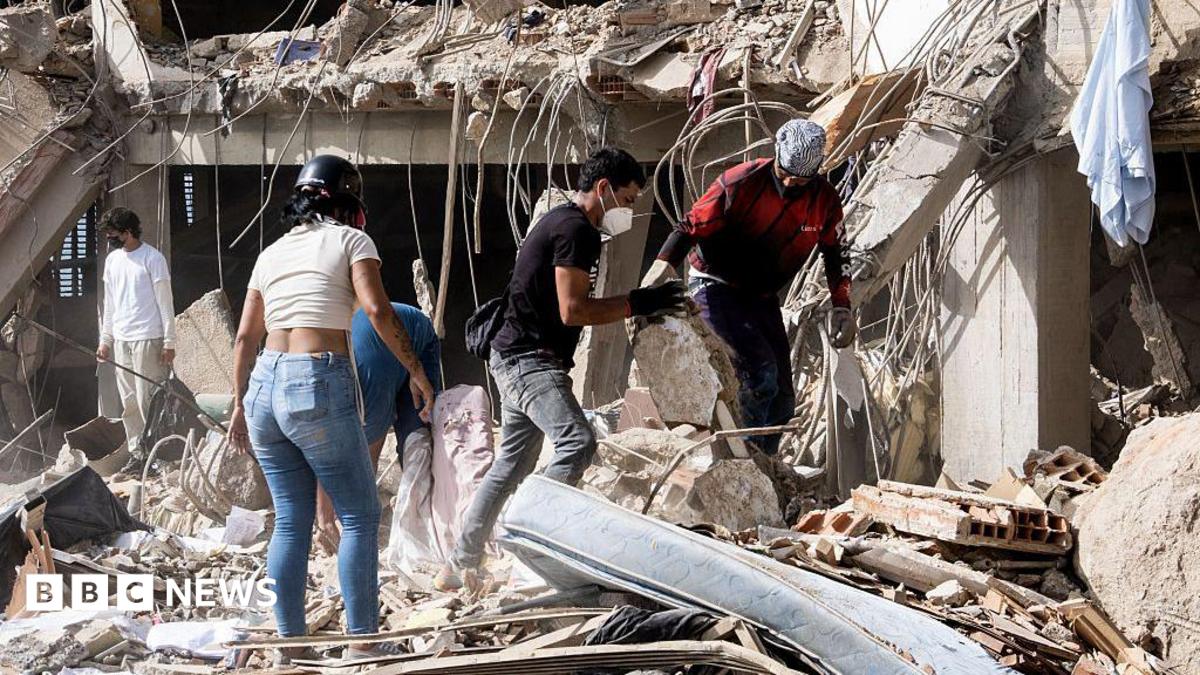
A desperate silence hangs heavy over Venezuela’s coastal state of La Guaira, broken only by the frantic shouts of families and the crunch of debris. In the grim aftermath of the devastating Venezuela earthquakes that struck on Wednesday, residents and volunteers are locked in a harrowing race against time, sifting through the remains of once-vibrant communities, desperately seeking any sign of life beneath the wreckage.
Here in La Guaira, bordering Caracas, the destruction is truly apocalyptic. Back-to-back earthquakes, registering magnitudes 7.2 and 7.5 respectively—the latter among the most powerful to hit the nation in a century—have transformed bustling neighborhoods into scenes of unimaginable horror. Two 17-story buildings within the Belo Horizonte residential complex in Catia La Mar simply vanished, leaving behind mountains of twisted metal and pulverized concrete.
The human toll mounts with each passing hour. Officials have confirmed at least 1,430 fatalities, a number expected to soar dramatically. The United Nations estimates a staggering 50,000 people are still unaccounted for, trapped or lost within the collapsed infrastructure. Hope, a fragile commodity, dwindles as the critical 48-to-72-hour window for live rescues slowly closes.
While national rescue teams are critically scarce, international specialists from Mexico, Spain, the US, and the UK have begun arriving, injecting a much-needed, albeit insufficient, surge of support. Jorge Rodríguez, President of the National Assembly, acknowledged the tragedy’s immense scope, stating, "Every person saved is a miracle. We will not hide anything about the scale of this tragedy."
The Desperate Search Amidst Venezuela Earthquakes
In Catia La Mar, a town particularly ravaged, an oppressive pallor hangs over everything. Surviving structures are few and far between. Interim President Delcy Rodríguez assures the government is deploying a "comprehensive rescue response," and vital food and water supplies have been distributed to survivors. Yet, the human cost of these Venezuela earthquakes transcends statistics, revealing itself in agonizing personal stories.
Jesús Suárez, having traveled 200 kilometers, gazes at a pile of rubble where he believes his son, Jean, lies buried. "There’s no information at all," he whispers, his voice heavy with despair. "People who know him say they didn’t see him come out or anything." His dilemma mirrors that of countless others: "It’s impossible to rescue him… There is no sophisticated equipment here. A human being alone cannot do it – it’s too dangerous."
Nearby, the family of 31-year-old Carlos Eduardo clings to a faint thread of hope. They know where he is. "Carlos, Carlos, son…" they called, and an hour and a half ago, a faint groan answered. Since then, silence. But he had gone quiet before, only to make a sound again. They wait, agonizingly, for specialized help.
Rescue operations are frequently hindered by traffic and desperate crowds. Soldiers and volunteers plead for silence, straining to catch any sound from beneath the concrete tomb. Drones, often privately owned, crisscross the skies, providing aerial views for families huddled around screens, searching for a familiar piece of clothing, a strand of hair, anything that might offer a clue about their missing loved ones.
As the days pass, a new horror emerges. "There’s a smell… the dead are already being felt. That’s going to make us and the children sick," says Glendys Delgado, whose nearby buildings collapsed without official government assistance. Locals from Caracas have stepped in, bringing much-needed food. Deiyer Gabril, 27, echoes the sentiment: "Macuto, Caribe… everything over there is bad. And we can all feel the odour."
While the immediate response was slow, international support is gaining momentum. By Friday, 861 volunteers from a coalition of countries, including Mexico, the US, El Salvador, Switzerland, and Colombia, were actively engaged, with more inbound. Interim President Rodríguez reportedly spoke with US President Donald Trump and Secretary of State Marco Rubio, securing renewed commitments for rescue teams and aid supplies. The magnitude of these Venezuela earthquakes demands a robust and sustained global effort. As international assistance trickles in, joining the valiant local efforts, the sheer scale of the challenge underscores the vital role of global disaster response initiatives in such devastating events.
Amidst the widespread destruction, human resilience shines through, albeit often shadowed by profound grief. Alexandra Gabino, 28, now shelters with her husband and two young children in their car at the damaged Simón Bolívar International Airport. She recounts the terrifying moment the ground shook, her children screaming as a neighboring building crumbled. Her husband, despite the instability, attempts to retrieve essential documents from their fifteenth-floor flat. "It’s painful to be left with nothing," she says, her voice trembling. "My mother lost her home, we lost our home, we have nothing. You try to stay strong for your children." Her raw honesty captures the collective anguish: "Everyone says what matters is that you’re alive – and yes, but everything you’re going through hurts: seeing people suffer, hearing people scream, seeing children trapped, and the helplessness of not being able to do anything… You try to be strong, but it hurts."
About the Author