
Powerful 7.7-magnitude earthquake kills at least 38 in Indonesia
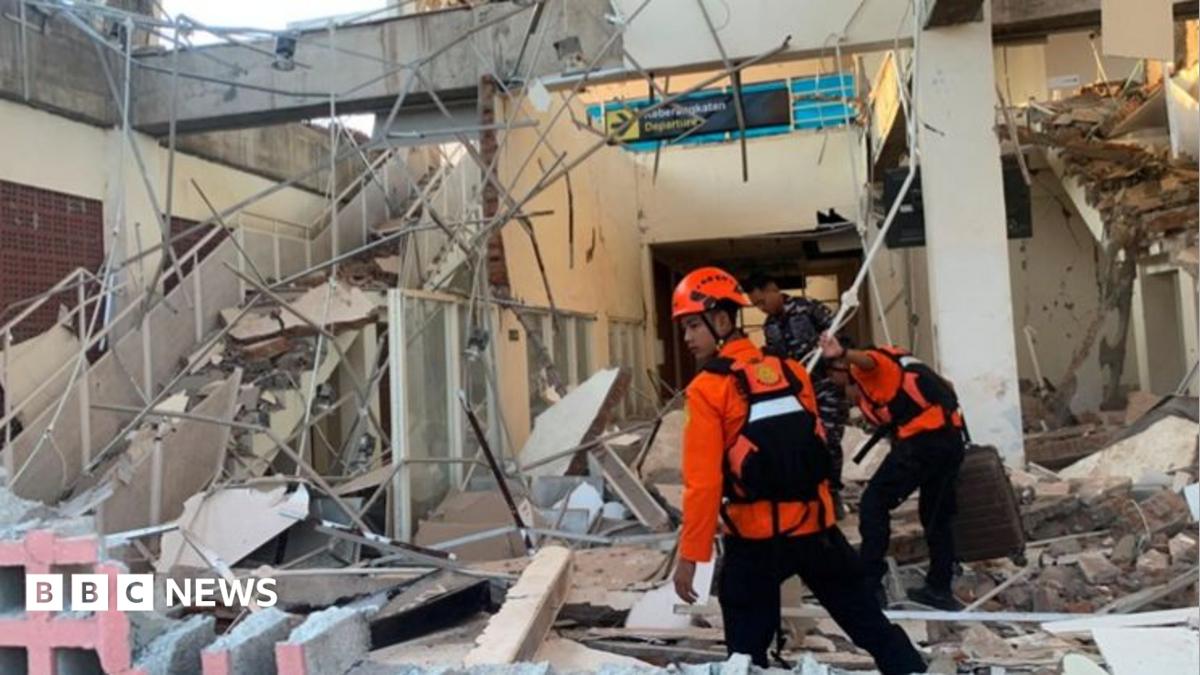
A powerful 7.7-magnitude earthquake has unleashed devastation across Indonesia’s Flores island, tragically claiming at least 38 lives. Early Saturday, the nation’s disaster mitigation agency confirmed the rising death toll. A desperate search and rescue operation rapidly mobilized across affected regions, with several individuals reported injured to varying degrees.
The seismic event, striking just before 05:00 local time (22:00 GMT Friday), originated at a shallow depth of only 15km, a factor known to amplify destructive surface effects. This initial colossal jolt was followed by dozens of unsettling aftershocks, one registering a significant magnitude of 6.1, leaving buildings compromised and residents terror-stricken across the vast area.
Eyewitness accounts paint a harrowing picture. At Maumere port, surveillance footage captured immense concrete slabs detaching from the terminal, crashing down upon unsuspecting passengers awaiting an inter-island ferry. Shockingly, the gangway to a ship buckled, flinging some individuals directly into the sea. East Nusa Tenggara province governor, Emanuel Melkiades Laka Lena, grimly reported that many victims perished in their sleep, crushed by collapsing rubble. The sheer force of this Indonesia earthquake was truly terrifying.
The Immediate Aftermath of the Indonesia Earthquake
Residents recounted terrifying moments. Arnold Welianto, from Talibura village, described being abruptly jolted awake by “very strong shaking,” his immediate instinct to rush to his child’s room. He noted that many villagers instinctively fled towards higher ground, some witnessing the sea receding — a chilling precursor that ignited widespread panic and prompted self-evacuation into the hills before a formal tsunami warning was issued. While a tsunami warning was indeed put in place, it was mercifully lifted after approximately three hours when no significant sea level rise materialized.
The National Disaster Mitigation Agency (BNPB) has confirmed three fatalities in Sikka province, six in Manggarai, and five in East Manggarai. Additionally, two individuals are gravely injured, with eleven others sustaining minor injuries. Over 2,000 people independently evacuated or relocated to safer zones following the initial tremor and subsequent warnings. Many residents, like Yulian Juita Ekalia, a university lecturer from Ruteng, remain too fearful to re-enter their homes, opting to cook outdoors amidst the lingering threat of aftershocks. She described the sensation as being “on a trampoline — it was really scary.”
Assessing the full scope of destruction in this remote, mountainous terrain will be a protracted effort. Preliminary assessments, however, indicate catastrophic damage: 54 homes utterly ravaged, five healthcare facilities compromised, three places of worship, six government buildings, an educational institution, and a warehouse severely impacted. Manggarai province appears to bear the brunt of the devastation. Authorities urge calm and advise citizens to steer clear of coastal areas and any structures exhibiting visible damage from the Indonesia earthquake.
Indonesia’s geographical location, perched atop the volatile intersection of three major tectonic plates, renders it inherently vulnerable to intense seismic activity and volcanic eruptions. The scale and impact of this Indonesia earthquake serve as a stark reminder of the nation’s constant battle against nature’s raw power.