
‘They will attack me if I stay’: immigrants in South Africa flee for safety amid violence and anti-foreigner protests
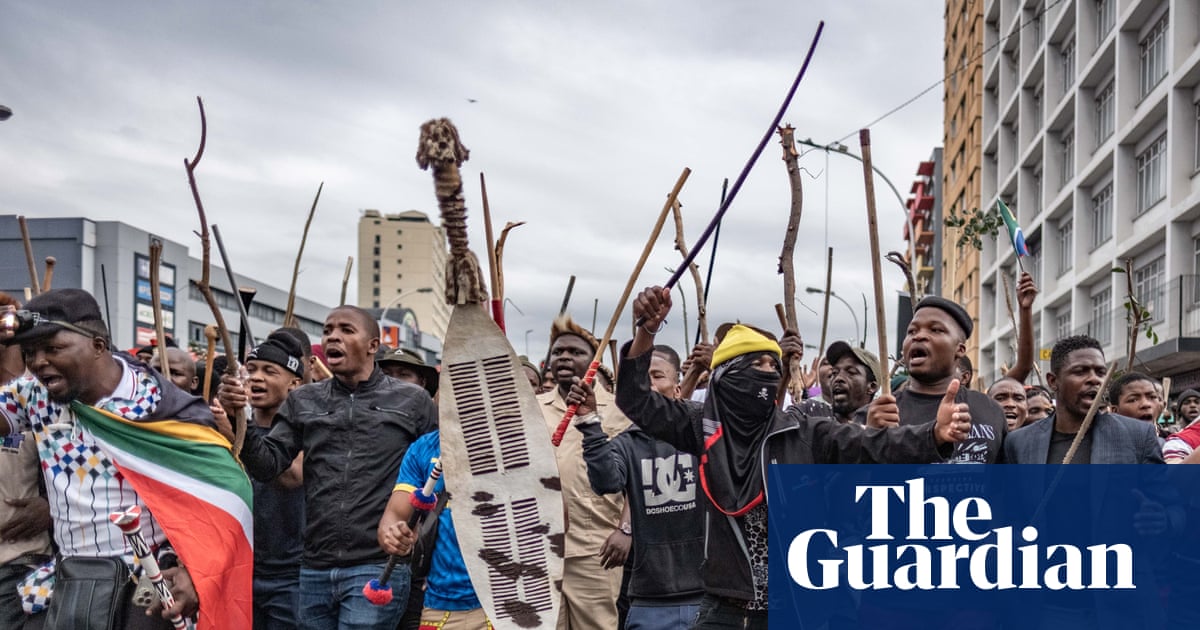
South Africa held its collective breath this week as widespread anti-migrant protests erupted across the nation. A weeks-long campaign against foreign nationals culminated in Tuesday’s mass demonstrations, leaving at least four dead and tens of thousands scrambling for safety. In Durban, the coastal city bracing for the worst, streets were eerily quiet, shops shuttered, a palpable tension hanging heavy in the humid air.
More than 2,000 anti-foreigner protesters, many clad in traditional Zulu attire, marched through Durban’s city centre. They brandished sticks and clubs, their rallying cry of “Abahambe!” (isiZulu for “They must go!”) echoing menacingly through the urban canyons. These campaign groups had issued an arbitrary deadline: undocumented immigrants, they declared, must depart the country by June 30th. A chilling fear permeated the immigrant communities: these marches, many believed, could quickly spiral into outright violence.
Escalating Tensions and the Dread of Anti-Migrant Protests
In the days preceding this arbitrary cutoff, thousands abandoned their homes. Many slept rough on pavements, in open fields, or crammed into makeshift camps, their sole hope resting on repatriation to their birth countries. African governments have responded, organizing buses and planes; police estimate over 25,000 individuals have been sent home. Just 50 miles away, in Pietermaritzburg, where a 29-year-old Malawian national was tragically killed by a mob following earlier reports of violence on June 19, according to investigative reports, hundreds of desperate families had camped for days outside a derelict building.
On the eve of the June 30th deadline, a somber queue snaked through an overgrown garden. Authorities raced against time to facilitate departures. Weary mothers clutched their children near flickering campfires, while others heaved tightly packed belongings onto buses bound for South Africa’s northern border.
Jackson Makungwa, a 29-year-old from Malawi, stood in that line, two small bags representing a decade of life built in South Africa. Once, he’d viewed the country as a “land of hope.” He had lived legally, yet for two years, the system had denied him a work permit renewal. “It’s not like I want to be illegally in the country,” he sighed, “but the system doesn’t allow me to be here legally.” His mother’s pleas to leave had finally broken through after a friend was brutally attacked. “They said the deadline is the 30th, so they will attack me if I stay.” On his phone, a photograph of his two-month-old son, born to a South African mother. He had been unable to secure travel documents for the infant. “I was forced to leave him behind,” Makungwa choked out. “He turns two months old today.”
In a separate makeshift camp, Lydia Mpingashato, a Zimbabwean migrant, learned of her dismissal as a cleaner. Children played amidst women cooking over open fires. Landlords, fearing retribution for housing immigrants, had evicted many, even those with legal papers. Days earlier, on June 27th, while waiting for a taxi in the township she’d called home for 17 years, Mpingashato was threatened: “He said he would burn my house and kill my family.” Her 17-year-old son, forced to abandon the only home he’d ever known and his South African friends, told her, “Actually, they never loved us.”
For many South Africans, immigrants are a convenient scapegoat for the country’s staggering unemployment and high crime rates. Philile Ntuli from the South African Human Rights Commission notes: “Xenophobia and Afrophobia… emerge where economic insecurity, high unemployment, inequality, weak governance and poor migration management intersect.” South Africa, home to an estimated 2.4 million foreign nationals, both documented and undocumented, has a dark history of anti-immigrant violence. In 2008, xenophobic riots claimed 62 lives and displaced over 150,000. Another wave in 2015 resulted in at least five deaths. The current anti-migrant protests underscore a deep-seated, persistent issue.
In response, the government has intensified its crackdown on undocumented immigration, with police reporting over 50,000 arrests since January. President Cyril Ramaphosa recently met protest leaders, sternly warning against “vigilantism.” Yet, as the recent marches unfolded, a heavy security presence couldn’t entirely dispel the underlying menace. Helicopters circled above Durban; police and private security watched from armored vehicles. Organizers urged peace, but some marchers issued thinly veiled threats. As the crowd passed dilapidated apartment blocks, protesters pointed at families in windows, yelling for them to leave, making chilling throat-slitting gestures. “I can smell the foreigners,” declared one man carrying a shield.
“We have been talking nicely. Tomorrow, we’re not going to talk. We take action,” asserted Nkosi Ndlovu, a 48-year-old pastor. He accused immigrants of corrupting local youth with drugs. Mfundo Zulu, 40, lamented that immigrants took jobs by accepting lower wages. “Those are our kids, our youth are dead,” she said, gesturing towards a nearby homeless camp. She believes life will improve now that thousands have fled. “We don’t hate them, but they overstayed,” her friend added.
Mukandjwa Shomri of the Southern Africa Refugee Organisations Forum, however, believes the government is not doing enough to hold perpetrators accountable. “When you try to open a case with the police, they will first ask for your papers,” he stated. “We are being attacked in the streets, in the community and administratively.” Leon, an asylum seeker from the Democratic Republic of Congo, now hiding in a safe house after his shop was attacked, expressed profound regret. “Even the police are telling us openly that we are tired of you, you must leave our country,” he whispered, his voice trembling. He fears that after the 30th, “it will be even worse.” Once a “country of hope,” South Africa has become a place where refugees “are just living like somebody who is already dead.”