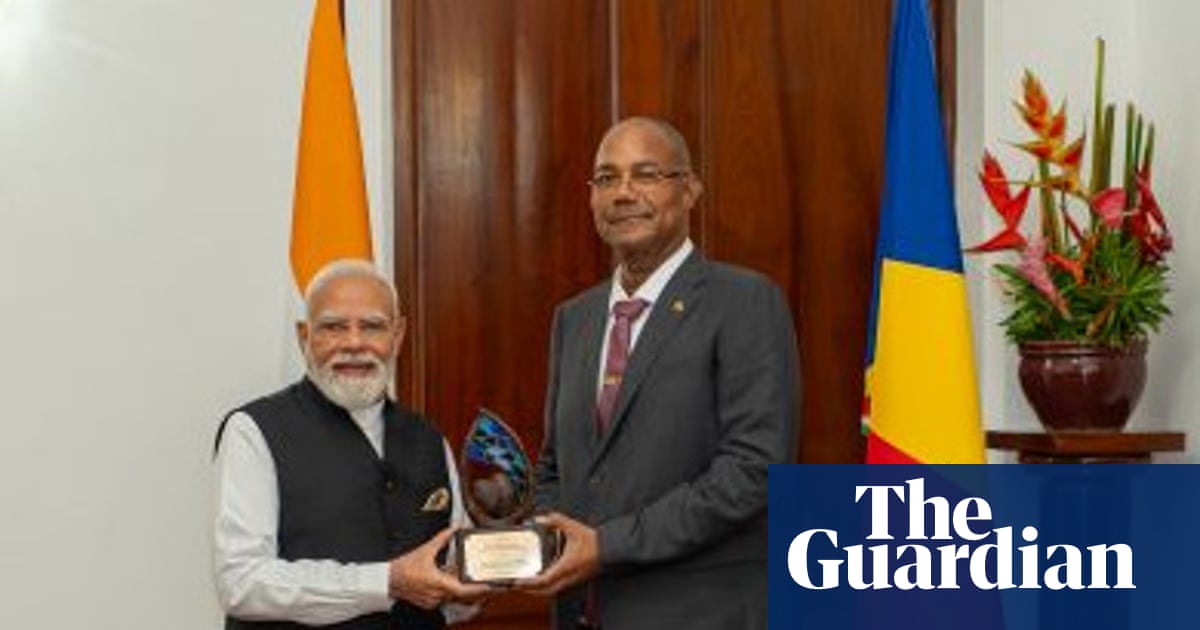
A diplomatic dust-up has quickly overshadowed Indian Prime Minister Narendra Modi’s recent visit to the Seychelles, following the hasty presentation of a questionable honour. What began as a ceremonial moment has spiraled into a full-blown Modi Awards Controversy, drawing sharp criticism and raising eyebrows globally. At the heart of the storm is the “Guardian of the Blue Horizon” award, bestowed upon Modi by Seychelles President Patrick Herminie.
The lavish affair, meant to highlight India’s “green leadership,” took a peculiar turn almost immediately. Scrutiny revealed a certificate riddled with errors: “republic” was misspelled as “repubblic,” and even “Seychelles” appeared as “Seycheeles.” More astonishingly, it quickly became public knowledge that the award itself was a mere three days old, crafted exclusively for the Indian Premier, making him its inaugural and sole recipient. To compound the intrigue, forensic analysis using AI detection software flagged the certificate as potentially AI-generated. Talk about a swift, albeit clumsy, creation!
Unpacking the Modi Awards Controversy: A Pattern Emerges
Opposition forces in India, particularly the Congress party, wasted no time capitalizing on the unfolding drama. “Give him any award, and he’ll come running,” quipped Congress politician Supriya Shrinate on social media, highlighting what many perceive as Modi’s insatiable appetite for accolades. She further lambasted the Seychellois government for being “in such a tearing hurry” that they couldn’t even get their own country’s name right. Modi’s Bharatiya Janata Party (BJP), however, swiftly countered, defending the award as a “proud moment for India” and a testament to his environmental stewardship.
The Seychelles foreign ministry, caught in the crossfire, issued a statement attempting to douse the flames. They claimed an “authentic and duly approved” version had now replaced a “working draft” accidentally circulated. Furthermore, they insisted the “Guardian of the Blue Horizon distinction is genuine.” Yet, for many observers, this swift course correction only added another layer of suspicion to the entire episode.
This isn’t an isolated incident. Critics have long noted Prime Minister Modi’s remarkable predilection for accumulating honours during his extensive overseas travels and even within India, a trend spanning his twelve years in power. Just last month, prior to his visit to Israel, its parliament reportedly established the “Medal of the Knesset,” an alleged highest honour, specifically for him upon arrival. He remains the sole recipient. Similarly, in 2019, he became the first — and only — honouree of India’s “Philip Kotler Presidential Award,” an honour initially touted as an annual recognition for national leaders but whose website now lies dormant, bereft of subsequent recipients. This consistent pattern amplifies the current Modi Awards Controversy, lending credence to the idea that these distinctions are often more about optics than genuine international recognition.
Nilanjan Mukhopadhyay, a prominent biographer of Modi, offers a candid assessment. He suggests that the global pursuit of these prizes is deeply intertwined with the Prime Minister’s his distinct political style. “The intention behind collecting these awards – often bestowed in circumstances that raise eyebrows – is to convey to supporters and potential converts that Modi is being honoured across the world over because of his greatness and that India’s rising clout is because of Modi’s personality,” Mukhopadhyay explained. Indeed, within the past year alone, Modi has also become the first foreign head of state to receive Ethiopia’s “Great Honour Nishan” and the “Order of the Republic of Trinidad & Tobago.” While the BJP maintains these awards simply recognize Modi’s international stature, the surrounding circumstances often tell a more intricate story.
About the Author