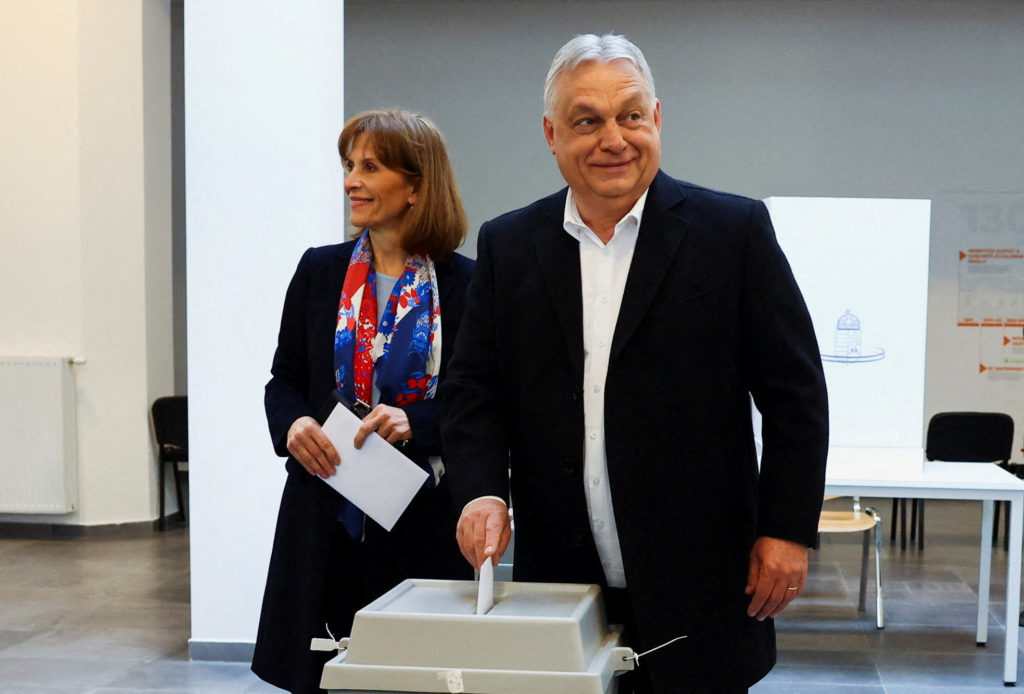
Hungarian Prime Minister Viktor Orban and his wife Aniko Levai vote during the Hungarian parliamentary election in Budapest, Hungary, April 12, 2026. REUTERS/Bernadett Szabo TPX IMAGES OF THE DAY
Introduction: The Most Consequential Vote in Decades
The political landscape of Central Europe is currently experiencing a massive seismic shift. Yesterday, April 12, 2026, citizens took to the polls for the highly anticipated hungary elections 2026. Billed by international political analysts as the most consequential European parliamentary election of the year, this vote could potentially end Prime Minister Viktor Orbán’s 16-year grip on power.
With the entire world watching closely from Washington and Brussels to Moscow the stakes have never been higher. The race has been widely framed as a fundamental choice between East and West, and between entrenched incumbent policies and promises of clean, modern governance. In this comprehensive post, we will break down the early voting results, analyze the unprecedented voter turnout, and explore what this means for the future of the European Union.
Read our latest breakdown on the 2026 Middle East Crisis and Global Politics here.
Early Results: A Massive Challenge to the Status Quo
When the polling stations officially closed on Sunday evening, the atmosphere in Budapest was absolutely electric. Early numbers quickly indicated that this was not going to be a standard, predictable election night.
Péter Magyar and the Tisza Party Take an Early Lead
The biggest story of the hungary elections 2026 is the explosive rise of the opposition catch-all party, Tisza, led by political challenger Péter Magyar. According to early preliminary results released with roughly 37% of the vote counted, Magyar’s Tisza party secured a shocking 51% of the support. In contrast, Prime Minister Viktor Orbán’s governing Fidesz party trailed behind at 40%.
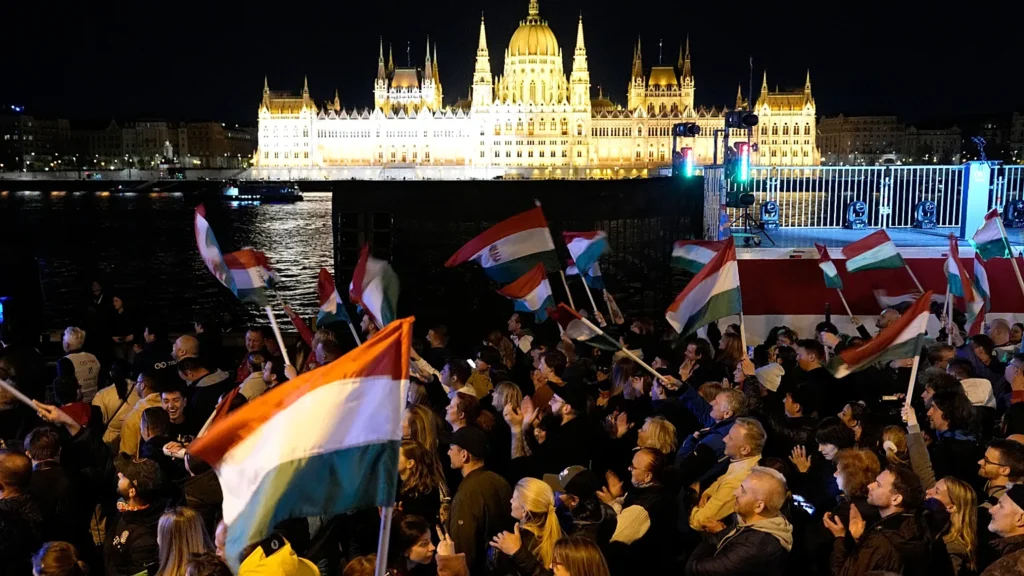
While these proportions will undoubtedly shift as rural and overseas votes are fully tabulated, the early lead has sent shockwaves through the political establishment. Thousands of passionate Tisza supporters crowded the promenade along the right bank of the Danube River, waving Hungarian flags and cheering as Magyar addressed the crowds, stating that he and his party were “cautiously confident” and asking supporters to prepare for a “big, Hungarian carnival” if the final results hold.
Unprecedented and Historic Voter Turnout
You cannot discuss the hungary elections 2026 without highlighting the sheer volume of civic engagement. According to the National Election Office, voter turnout by 6:30 p.m. had surpassed a staggering 77%. This represents a record-breaking number in the history of Hungary’s post-Communist elections. Gergely Gulyás, Orbán’s chief of staff, acknowledged the massive civic participation, noting that the record-high turnout proved that “Hungarian democracy is extremely strong,” even as Fidesz officials held their breath behind closed doors at exclusive, elite-only party events.
The Battle for Parliament: Navigating a Complex Electoral System
While the early popular vote heavily favors the opposition, winning the popular vote in Hungary does not automatically guarantee control of the government. The Hungarian parliamentary system has highly specific structural nuances.
Why the Popular Vote is Not Enough
To understand the ultimate outcome of the hungary elections 2026, one must look at how the 199 members of the National Assembly are actually elected. Hungary utilizes a mixed electoral system that systematically favors the winning parties in single-member constituencies. Furthermore, the allocation of list seats heavily relies on votes from ethnic Hungarians residing in neighboring countries a demographic that historically votes overwhelmingly for Orbán’s Fidesz party.
The Race for a Parliamentary Majority
Even if the Tisza party wins the overall popular vote, Fidesz could still mathematically secure a parliamentary majority. In tightly contested races, structural advantages such as external list votes and preferential mandates allocated to recognized national minorities could effectively grant Fidesz a critical bonus of four to six seats. This means that until every last ballot from rural districts and mail-in voters is counted, the battle for the required 100 seats to form a simple majority remains incredibly tense.
Follow live vote counting updates on Reuters or the BBC.
Global Implications: Why the World is Watching
The results of the hungary elections 2026 will ripple far beyond the borders of Budapest. Because Hungary is a critical member of both the European Union and NATO, the outcome of this election is a matter of international security and global economics.
Impact on the European Union and Ukraine
Prime Minister Viktor Orbán has famously maintained a highly controversial, “illiberal” stance within the EU, often blocking aid packages to Ukraine and maintaining unusually warm diplomatic ties with Russia and China. A victory for Péter Magyar’s Tisza party would likely signal a massive geopolitical pivot, realigning Hungary more closely with standard Western European policies and strengthening the unified EU front regarding the ongoing war in Ukraine.
International Observers and Next Steps
Due to the incredibly high stakes, the OSCE Office for Democratic Institutions and Human Rights (ODIHR) deployed a massive Election Observation Mission. Hundreds of short-term and long-term multinational observers monitored the opening of polling stations, the voting process, and the tabulation of ballots. The organization is scheduled to hold a major press conference today, April 13, 2026, to issue their preliminary findings regarding the fairness and transparency of the electoral process.
Conclusion: Waiting on the Final Verdict
The hungary elections 2026 have already proven to be one for the history books. With a record-breaking voter turnout and a fierce, highly competitive race between Péter Magyar and Viktor Orbán, the political destiny of Central Europe currently hangs in the balance. As the final votes are meticulously counted over the coming days, the world waits to see if Hungary will embrace a new era of governance or maintain its 16-year status quo.
About the Author