
Kolkata sings for Messi as World Cup fever takes hold
A pre-dawn chill hung heavy over Amartya Sen Udyan in Kolkata, West Bengal, as the clock ticked past 5:45 AM on a recent Saturday. Yet, approximately 300 devoted football aficionados, draped in blue and white, ignored the sodden ground and the grey sky. Their gazes were fixed on a colossal screen, where Argentina, the defending champions, clashed unexpectedly with the resilient Cape Verde in a nail-biting World Cup encounter. This fervent display wasn’t an isolated incident; it was a microcosm of the extraordinary Kolkata Messi fever that has utterly captivated the city.
Giant loudspeakers amplified the stadium roar, transforming the humble park into an arena vibrating with the intensity of a political rally or a pulsating rock concert. Walls and railings were adorned with countless blue-and-white flags, plastic footballs, and life-size cutouts of Argentinian heroes. Amidst the array of Mac Allister, Martinez, and Romero, one figure dominated: Lionel Messi. This gathering, the unofficial headquarters of the Kolkata Argentina Football Fan Club, epitomizes the city’s quadrennial eruption of passion for South American football, a fervor that reaches its zenith during the World Cup.
Rain had relentlessly lashed down all night, leaving the park a muddy expanse. But with the first hint of dawn, the sea of blue and white believers, some having arrived as early as 3:30 AM, stood in stark relief. They weren’t there for a religious service; they were there for Messi. As the game improbably spilled into extra time, a collective sense of jeopardy, mingled with the thrill of prolonged spectacle, permeated the anxious crowd.
Then, a moment of magic. Argentinian defender Lisandro Martinez unleashed a left-footed rocket into the net’s roof. The local faithful exploded! They filmed themselves, arms pumping, screaming, and high-fiving. This curious blend of self-awareness and raw spontaneity defines the millennial football fan in Kolkata, a generation weaned on reels, podcasts, and vlogs, starkly different from their predecessors who meticulously compiled scrapbooks and hoarded dog-eared magazines.
Soon, a singular chant began to rise, a name echoing globally that night. The Bengalis, with their unique cadence, stretched the first syllable: “MAY-SI! MAY-SI! MAY-SI!”
Kolkata Messi Fever: A City’s Obsession
At 39, Messi was competing alongside an extraordinary cohort of veterans: Croatian maestro Luka Modric and German custodian Manuel Neuer, both 40, and, of course, his legendary rival, Cristiano Ronaldo, 41, who had matched him stride for stride throughout their careers. Yet, amidst this constellation of talent, including younger stars like Mbappé, Haaland, and Kane, and emerging prodigies such as Yamal and Olise, the footballing collective consciousness of Kolkata elevated Messi to a realm entirely his own.
Despite being a perennial contender for the title of the greatest player of all time, Messi often seems to embody the spirit of an underdog against formidable opponents like France or Spain. The Argentinian squad boasts a plethora of stars, but it was Messi who single-handedly netted all six goals to guide them through the group stage. And whenever his team faced adversity – be it against Cape Verde, Egypt, Switzerland, or England in the semi-final – those praying for his intervention were invariably rewarded. Kolkata fans, keenly aware that this might be his final World Cup, yearn to savor every moment until the tournament’s conclusion.
Debjoy Biswas, a lifelong Argentina fan and Kolkata native, recently returned from witnessing Argentina’s group stage matches in North America. “It’s one thing to watch Messi play on TV,” he explained, “and another entirely to see him from ten meters away. On television, you observe his masterful ball control and jubilant celebrations. But live, you witness his off-ball movements, his uncanny anticipation, his spatial awareness. It’s the closest I’ve come to footballing nirvana.”
The devotion extends to the Patra family, whose lives revolve around Messi and Argentina. Their home in Nawabganj, North Kolkata, proudly sports blue and white stripes. Above their ‘Argentina tea stall,’ a colossal blue flag billows. They celebrated Messi’s 39th birthday with an 18kg cake and distributed free jerseys to local children. Sapna Patra recounted, “My daughter, a professional classical dancer, has named her son Leo. Sometimes, she even asks me, ‘Why did you send me to a dance school and not a football academy?'” The Kolkata Messi fever is truly generational.
Kolkata, a city enamored with football since the late 19th century, is arguably South Asia’s greatest footballing hub, despite never being represented at a World Cup. This absence fuels an unparalleled intensity, making its supporters the most visible embodiment of Indian footballing excellence. This enduring passion, as articulated by the legendary Indian footballer Subimal ‘Chuni’ Goswami, alongside literature and the arts, is what makes Kolkata uniquely special within India. Football’s roots here run deep, a complex cultural legacy intertwined with empire. To delve deeper into the history of the sport, you can explore its origins worldwide.
The city’s footballing landscape has long been defined by fierce local derbies, particularly the rivalry between Mohun Bagan and East Bengal, which draws crowds exceeding 50,000. “This longstanding rivalry has fostered not just a binary fandom, but an intellectual capacity for football unique to India,” notes Kolkata-based analyst Debanjan Banerjee. “Football is discussed year-round; it’s the thread connecting generations.”
Last December, Messi’s highly anticipated visit to Kolkata descended into chaos when he departed prematurely, prompting fans to breach barricades. Banerjee views this not as disorganization, but as a reflection of the profound emotional pull football icons exert in Kolkata. “When you have larger-than-life idols, you cannot draw boundaries,” he stated.
Yet, the current Kolkata Messi fever is also a culmination. Veteran journalist Indrajit Hazra recalls a time in the 1980s when supporting Argentina was a minority position. The turning point was the 1986 World Cup, the first widely televised in India, which saw Diego Maradona mesmerize millions. Before then, Brazil was the gold standard. Hazra reminisces, “Pele was considered the greatest. Maradona changed everything in ’86. We didn’t just read about him; we saw him with our own eyes on TV.”
The World Cup cycle, every four years, offers intriguing insights into the sport’s shifting tides. Gourab Goswami, an English professor and lifelong Brazil fan, remembers the widespread belief after Argentina’s 2018 World Cup exit that Messi’s genius was confined to FC Barcelona. “The fervor around Messi has truly surged in recent years, especially after he clinched the Cup for his country in 2022,” Goswami observed. “Now, the Barcelona Messi has receded, replaced by the blue and white Messi of Argentina.”
This year, the narrative around Cristiano Ronaldo, once equally adored in Kolkata, differed markedly. At 41, his decline was palpable, his media appearances tinged with defiance. This created a fascinating split: while Ronaldo fans typically backed Portugal, not all Portugal supporters championed Ronaldo, many feeling the team’s strategy was hampered by their fading captain. When Portugal was eliminated, few in Kolkata mourned Ronaldo, viewing him as a former saint who overstayed his welcome, inadvertently diminishing his legacy. In contrast, Messi, slight yet superhuman, remains the enduring colossus, chasing one final fairytale for Argentina.
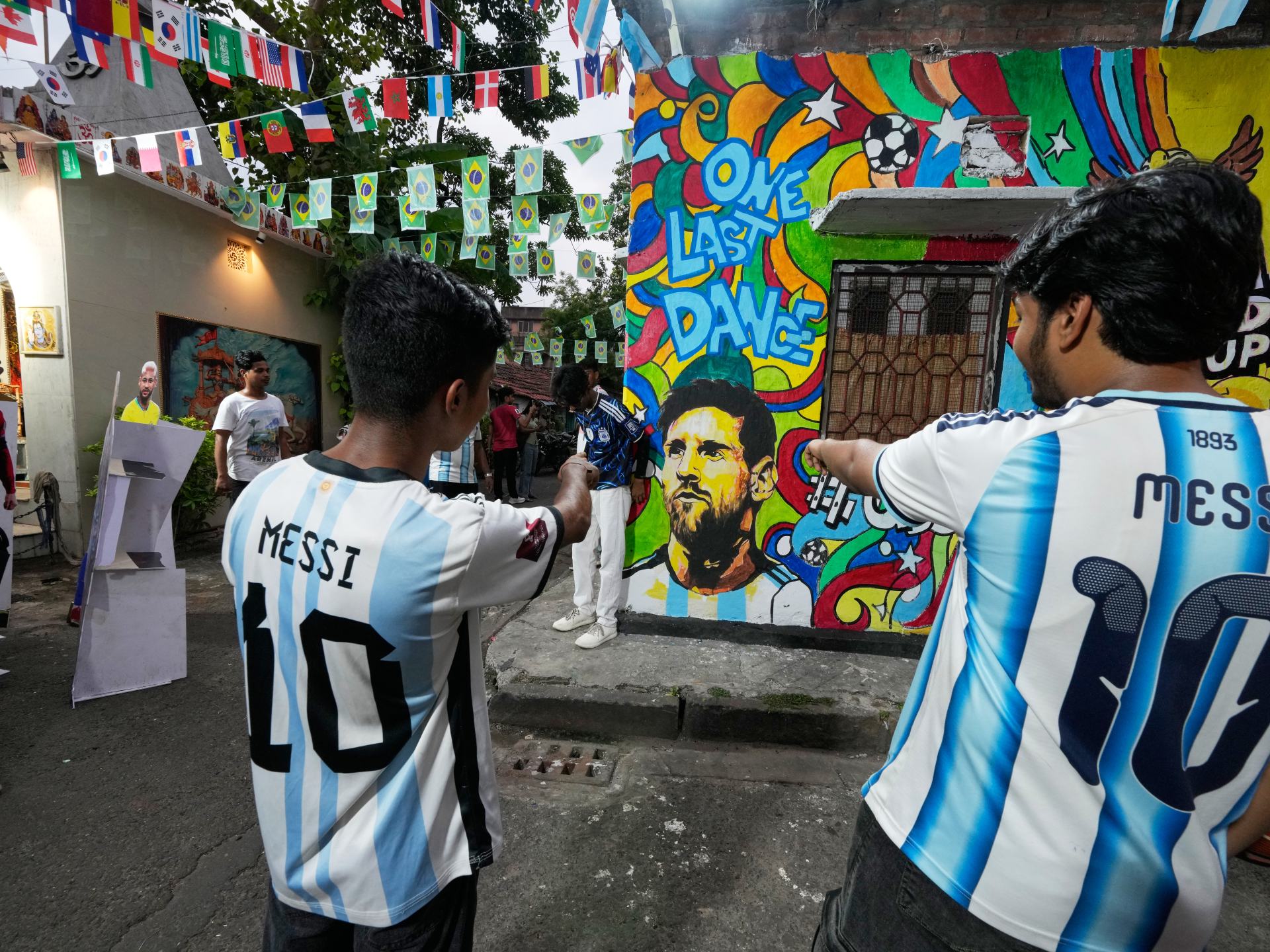
Even in “FIFA galli” (Fakir Chakraborty Lane), a historically Brazil-supporting neighborhood, murals of Messi and even Argentinian flags now share space with odes to Neymar. It appears the current Kolkata Messi fever has swept up a new generation of fans, leaving Ronaldo far behind, and signaling a significant shift away from Brazil’s long-held dominance towards Argentina, or other European contenders.
Despite these changes, a tenacious Brazilian tradition endures. A colossal green-and-gold flag still flies proudly near Salt Lake Stadium, a testament to a lineage stretching from Pele to Neymar. This scene, with rows of laundry drying below, serves as a poignant reminder of football’s working-class roots, a game for everyday people seeking respite from life’s daily grind, looking up at fluttering flags and the thrill of the beautiful game.
Sudhansu Singh, a 34-year-old Brazil fan and Subway server, articulated a common sentiment: “Brazil aren’t the same without Neymar. I prefer playing football to watching football.” A true representative of the Kolkata school, his words echo the city’s fundamental devotion: in Kolkata, the love for the game always begins with feet on the pitch.