
Uttarakhand BJP Chief Defends ‘Purification’ of Kharge Rally Venue | Haldwani Row Explained | News18
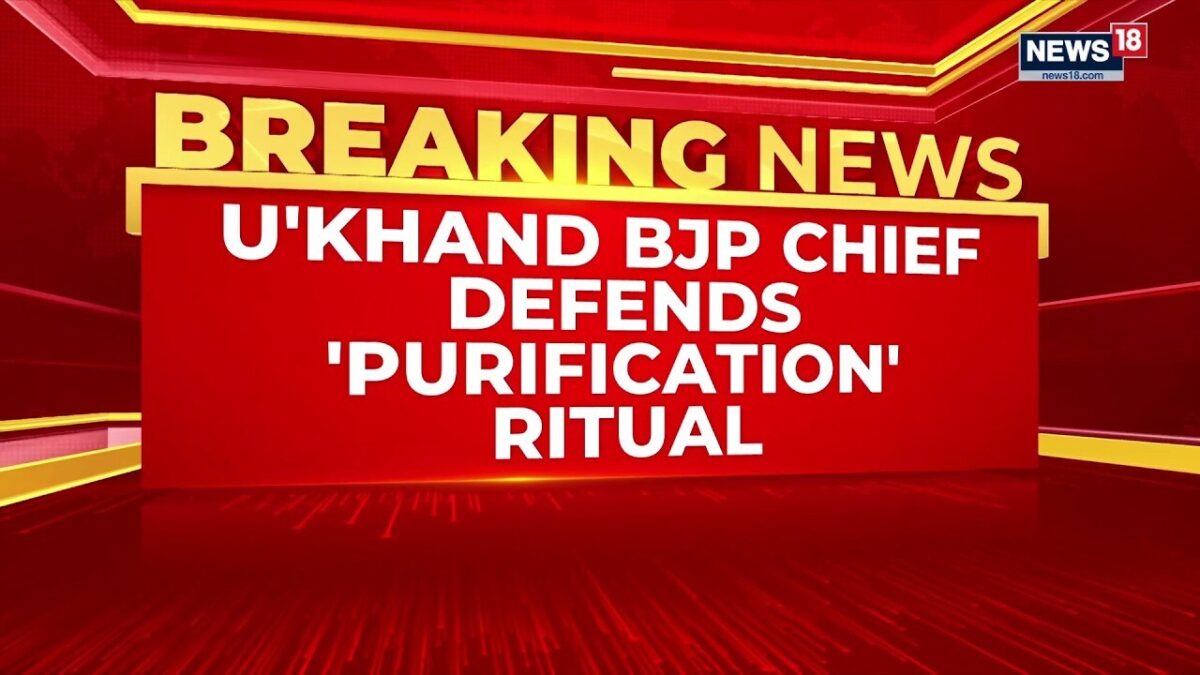
A simmering political firestorm has erupted in Uttarakhand, centering on the alleged ‘purification’ of the Haldwani Ramlila Maidan following a significant rally by Congress President Mallikarjun Kharge. The incident has not merely triggered a war of words between the Bharatiya Janata Party (BJP) and the Indian National Congress but has also ignited a broader debate about political civility, religious sensitivities, and the symbolic use of public spaces in India’s vibrant, often contentious, democracy. The controversy, now known as the Haldwani purification row, escalated dramatically after Uttarakhand BJP chief Mahendra Bhatt staunchly defended the ritual, asserting that the venue had been ‘defiled’ by slogans and demanded its cleansing to restore its sacred character.
The events unfolded after Kharge, a prominent figure and senior leader of the Indian National Congress, addressed a gathering at the historic Ramlila Maidan in Haldwani. While political rallies are commonplace across the nation, what followed was anything but. BJP workers reportedly performed a ‘purification’ ceremony, involving the sprinkling of Ganga jal (holy water from the Ganges River), a ritual traditionally associated with cleansing and sanctifying spaces perceived to have been desecrated or polluted. This act, coming directly after a rival party’s event, was swiftly interpreted by the Congress as a grave insult and a deeply divisive political stunt.
The Intensifying Haldwani Purification Row: A Battle of Narratives
Mahendra Bhatt’s defense of the purification ritual was unequivocal. He argued that the ground, a site often used for religious and cultural events like the annual Ramlila plays, carries an inherent sanctity. According to Bhatt, the slogans raised during the Congress rally were not just political rhetoric but constituted a ‘defilement’ of this sacred space, necessitating the subsequent cleansing. This perspective attempts to frame the act not as a political jab, but as a preservation of cultural and religious integrity, a narrative often employed in India’s religiously charged political landscape. Such incidents are not unheard of in Indian politics, where even seemingly trivial actions can take on profound symbolic meaning, often amplifying underlying tensions between political rivals, as seen in previous debates such as the Sonia Gandhi Vande Matram Row.
The Congress, understandably, reacted with outrage. Mallikarjun Kharge himself brought the issue to the floor of Parliament, condemning the act as discriminatory, casteist, and an affront to democratic principles. Critics from the Congress camp highlighted the irony of a political party claiming to uphold democratic values while simultaneously attempting to ‘purify’ a public ground used by political opponents. They questioned the very notion of ‘defilement’ by democratic discourse, arguing that such actions undermine the spirit of healthy political competition and inclusivity.
Interestingly, the national leadership of the BJP adopted a more conciliatory tone, at least initially. BJP president J.P. Nadda, a figure of significant stature within the party, expressed regret over the incident and reportedly distanced the party from the ceremony. This suggests a potential recognition of the controversy’s negative optics on a national scale, or perhaps an attempt to de-escalate a situation that could be seen as alienating a significant section of the electorate. However, Bhatt’s subsequent robust defense from the state unit indicates a complex interplay of regional sentiments and national party directives, highlighting the granular, often localized, nature of Indian political battles.
Religious Symbolism and Political Divides
The Ramlila Maidan, much like many public grounds in India, serves as a versatile space – a venue for religious festivals, cultural performances, and, crucially, political rallies. This dual identity makes it fertile ground for symbolic disputes. The act of ‘purification’ is deeply rooted in Hindu traditions, where the concept of ritual purity dictates various aspects of life, from food to physical spaces. When this deeply embedded cultural practice is invoked in a political context, it invariably intertwines religious sentiment with partisan politics, often with explosive results.
For many, the Haldwani purification row transcends a mere local disagreement. It speaks to a broader trend of weaponizing cultural and religious practices for political leverage. In a pluralistic society like India, such incidents can deepen societal fault lines, raising questions about secularism, respect for diverse viewpoints, and the boundaries of political expression. The episode underscores the delicate balance political parties must maintain when appealing to their base while simultaneously upholding the foundational principles of a secular democracy.
As the dust settles, the ramifications of this incident will likely reverberate beyond Haldwani. It serves as a stark reminder of the potent mix of religion and politics in India, where even a simple rally can spark a heated controversy that challenges the very fabric of public discourse and democratic engagement. The coming weeks will show whether this row will be confined to local political sparring or if it will become a defining moment in the ongoing national political narrative.