In a stunning turn of events that underscores the escalating regional tensions, the United States military has successfully executed a daring US Airman Rescue mission, extracting a missing F-15 fighter jet crew member from deep within Iranian territory. The airman, whose F-15E Strike Eagle was reportedly shot down over southern Iran on Friday, is now confirmed “SAFE and SOUND!” according to President Donald Trump’s Sunday morning social media post. This extraordinary operation unfolded amidst a fierce hunt by Iranian forces, painting a dramatic picture of survival against overwhelming odds. The incident has ignited a firestorm of questions regarding the nature of the engagement and the meticulous planning behind such a high-stakes extraction.
Unraveling the US Airman Rescue: A Daring Operation
The circumstances surrounding the recovery of the downed airman remain shrouded in a fog of war, yet emerging details paint a vivid picture of one of the most complex combat search and rescue (CSAR) missions in recent memory. After the jet’s fiery descent, both of its two crew members ejected; one was swiftly rescued in an earlier operation. The other, however, found himself isolated, literally “behind enemy lines in the treacherous mountains of Iran,” as President Trump described.
For over 24 grueling hours, the lone colonel evaded capture, armed only with a handgun, navigating the rugged terrain. US officials, monitoring his location around the clock, orchestrated an intricate plan. Sources familiar with the mission describe it as “huge,” involving an engagement between US and Iranian forces. The CIA reportedly played a pivotal role, not only tracking the airman to a mountain crevice but also employing a strategic deception campaign. While the rescue attempt was underway, the agency cunningly spread word that the airman had already been found and extracted, creating vital confusion among the pursuers. Dozens of US aircraft were deployed into Iranian airspace for this precise and dangerous operation, remarkably achieving their objective without any American casualties, according to the President.
Meanwhile, Iranian state media countered, claiming the Islamic Revolutionary Guard Corps (IRGC) had shot down a US drone actively searching for the missing airman in southern Isfahan province. Such missions, known as CSAR, are the pinnacle of military training. Jennifer Kavanagh, director of military analysis at Defense Priorities, highlighted the rigorous preparation: “Their number-one priority is to stay alive and to avoid capture.” Aircrew members are extensively trained to move away from ejection sites, conceal themselves, and utilize survival techniques, drawing on local resources for sustenance. Iran’s IRGC also claimed that local nomadic tribes had shot down two Black Hawk helicopters that were part of the US Airman Rescue mission.
The Jet’s Downing and Location Details
The F-15E’s downing on Friday was first reported by Iranian state media, though the precise location remains contested. Initial reports cited two potential provinces: the mountainous Kohgiluyeh and Boyer-Ahmad, or the industrial powerhouse of Khuzestan. The earlier rescue of the F-15E’s pilot was not without its own perils; an A-10 Warthog aircraft was reportedly hit over the Gulf, its pilot ejecting before being recovered. Furthermore, a helicopter transporting the initial rescued pilot sustained small arms fire, injuring crew members, yet managed a safe landing.
BBC Verify corroborated a video purportedly showing armed individuals firing at these helicopters. Iran’s joint military command further asserted that new Iranian air defense systems were responsible for downing both US warplanes, according to the IRNA news agency.
Understanding the F-15E Strike Eagle’s Role
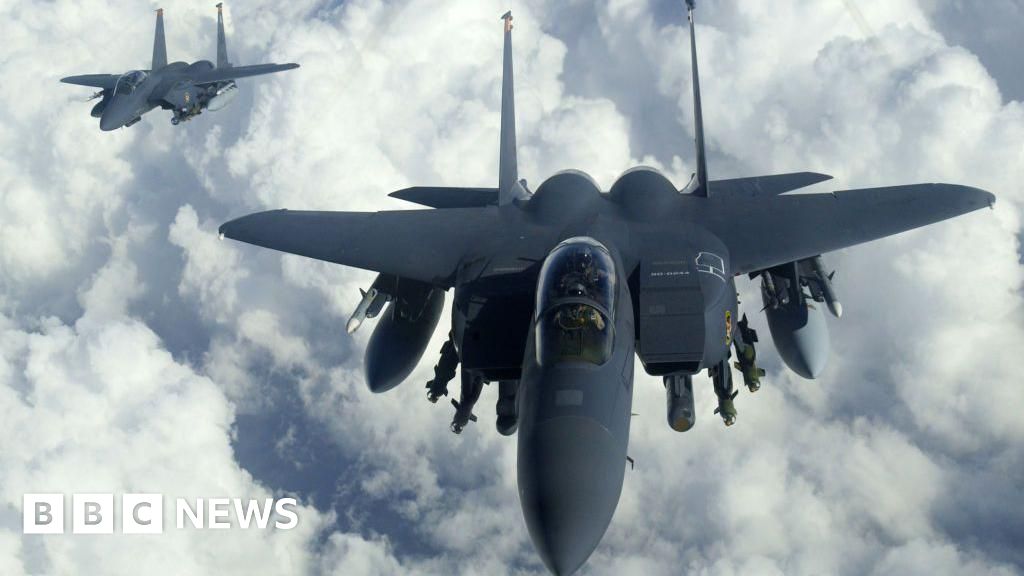
The F-15E Strike Eagle is an adaptable beast of the skies, engineered for a dual role: both air-to-ground strikes and air-to-air combat. In the Iranian context, these jets would most likely be performing defensive duties, intercepting Iranian drones and cruise missiles. Capable of deploying laser and GPS-guided precision munitions, alongside conventional bombs, the F-15E is a formidable asset.
Its two-person crew, comprising a pilot and a Weapons Systems Officer (“Wizzo”), allows for an effective division of labor, crucial in hostile environments where pilots must concentrate on evasion while the Wizzo manages targeting and weapon programming. While the specific weapon responsible for bringing down this particular US jet is unconfirmed, military analysts widely believe a surface-to-air missile (SAM) from Iran’s air defense network would be the most probable cause. The broader implications of this incident will undoubtedly be a topic of discussion in global foreign policy developments for weeks to come.
About the Author