
‘Who Laughs When India Is Insulted?’: BJP’s Veiled Jibe At Rahul Gandhi Over Foreign Leader’s ‘Vote Chor’ Remark
Introduction & Key Takeaways
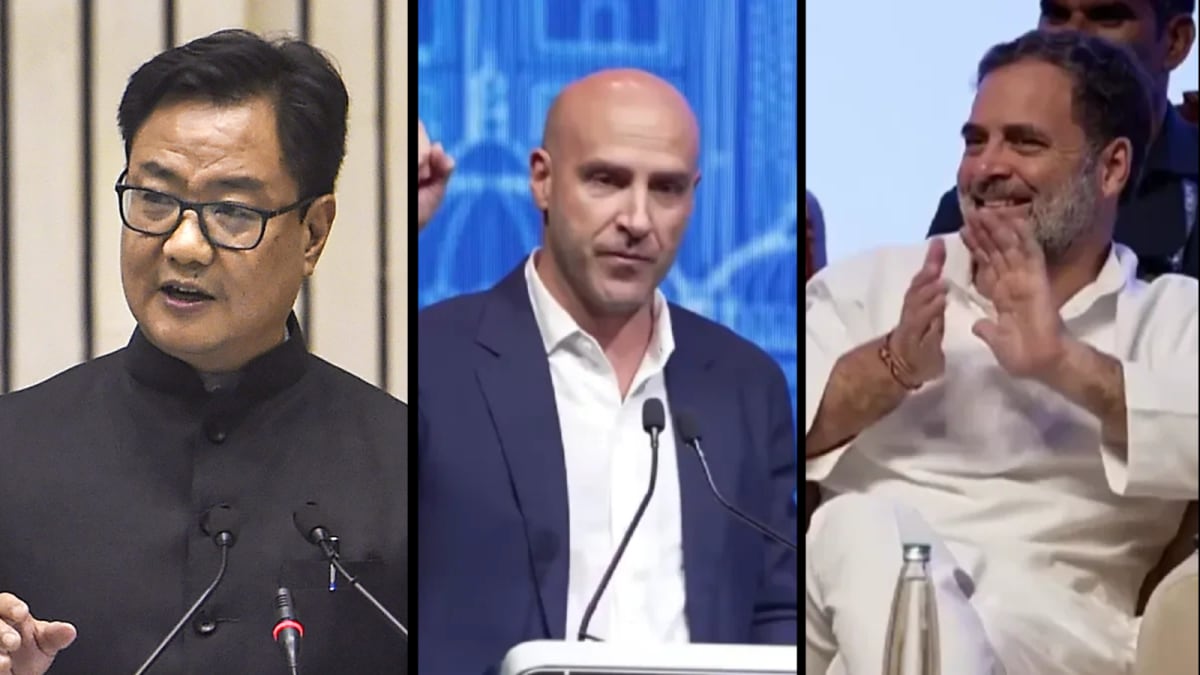
The intersection of domestic political strategy and international perception has reached a boiling point in India following recent events at the Congress Bharat Summit 2026. Parliamentary Affairs Minister Kiren Rijiju recently launched a sharp, veiled attack on the Leader of the Opposition, Rahul Gandhi, after the latter was observed laughing and applauding during a speech by an Italian politician. This incident has ignited a firestorm regarding the role of foreign figures in Indian political discourse and the patriotic obligations of national leaders.
- Minister Kiren Rijiju questioned the optics of Rahul Gandhi laughing at a foreign politician who insulted Indian democratic processes.
- The foreign guest, Giacomo Filibeck, utilized the slogan ‘Vote Chor, Gaddi Chhod’ to criticize current electoral roll revisions.
- The incident has drawn comparisons to previous political controversies involving foreign narratives in Indian elections.
- Opposition parties, including the BRS, have joined the BJP in condemning what they describe as the invitation of foreign interference in internal affairs.
Background & Context (What Just Happened?)
During the Congress Bharat Summit 2026 held in Hyderabad, Giacomo Filibeck, the Secretary General of the Party of European Socialists, took the stage to support Rahul Gandhi’s ongoing advocacy for clean voter rolls. During his address, Filibeck employed the provocative slogan ‘Vote Chor, Gaddi Chhod’ (Thief of Votes, Leave the Throne). This rhetoric was aimed at the ruling administration, specifically concerning the Special Intensive Revision (SIR) of electoral rolls. Rahul Gandhi’s visible approval, manifested through applause and laughter, became the focal point of the subsequent backlash.
The Bharatiya Janata Party (BJP), under the leadership of figures like Kiren Rijiju, promptly framed this interaction as a national embarrassment. The controversy highlights a recurring theme in modern Indian politics where the line between international diplomatic engagement and perceived external interference is frequently contested.
Root Cause & Deep Dive Analysis (Why Did This Happen?)
At the core of this tension lies the fundamental disagreement over how political dissent should be expressed and who should be allowed to validate that dissent. The BJP posits that when a national leader allows a foreign entity to disparage Indian democratic institutions on Indian soil, it compromises national sovereignty. This is not the first time Gandhi has faced such allegations. His 2023 remarks at Cambridge University regarding the status of Indian democracy provided the initial blueprint for the current narrative that he is engaging in the internationalization of India’s internal disputes.
The use of the term ‘Vote Chor’ is more than mere political mudslinging, as it strikes at the perceived legitimacy of the electoral process itself. By providing a platform for a European politician to validate this narrative, the Congress party has inadvertently provided the ruling party with a potent weapon: the accusation that the opposition is seeking foreign validation to delegitimize the incumbent government. This cycle of accusation and counter-accusation serves to deepen the polarization within the electorate, as both sides leverage the optics of the event to define their respective brands of patriotism.
Strategic Implications & Future Impact (What Does This Mean Globally?)
In the broader context, this event signifies the increasing convergence of global ideological movements with local political battles. The participation of international socialist figures in the Bharat Summit suggests a strategy to place Indian domestic issues on the global democratic discourse radar. However, the strategic cost may outweigh the benefits, as such alliances are easily re-contextualized by opponents as foreign meddling.
The long-term impact on political communication in India could be severe. If political parties continue to rely on international figures to amplify domestic criticism, the discourse will likely shift toward highly nationalist rhetoric. This makes the standard political process more volatile and increases the likelihood of legislative stalemates. Furthermore, the reliance on external voices signals that the domestic sphere is becoming increasingly incapable of resolving disputes without appealing to international audiences.
Conclusion & What to Watch Next
As the debate continues, it is crucial to monitor how the electorate perceives these accusations of external influence. For the BJP, the strategy remains clear: frame the opposition as disconnected from national sentiment. For the Congress, the challenge is to maintain their democratic critique without being painted as anti-national. The public response to this incident will likely determine whether future political summits will continue to invite international participation or if this event will serve as a cautionary tale against such cross-border alliances in the future.