
Why some B.C. farmers stay to fight, despite wildfire evacuation orders
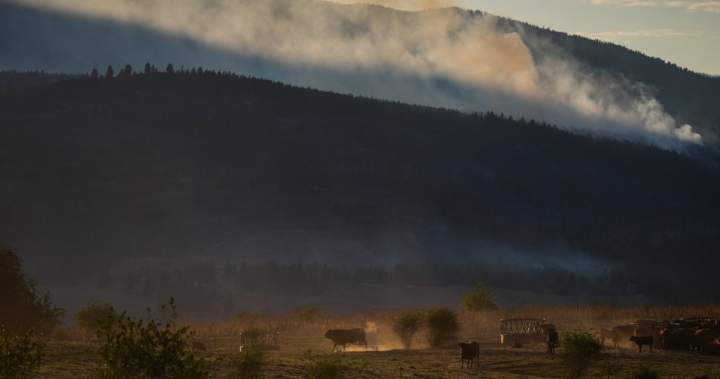
Amidst the escalating infernos ravaging British Columbia, an extraordinary, if controversial, phenomenon is unfolding: **BC wildfire farmers** are making the gut-wrenching decision to defy evacuation orders. These brave men and women, deeply rooted in their land and livestock, are choosing to stand their ground against nature’s fury, often equipped with little more than courage and makeshift firefighting gear. Their defiance, while at odds with official directives, springs from a profound, multi-generational connection to their properties and the animals under their care.
Take Tom Davison, for instance. After a 2021 blaze skirted his Vernon orchard, his son-in-law invested in firefighting equipment. What seemed like a once-in-a-century precaution proved invaluable when, on August 1, high winds catapulted flames right to their fence line. Davison’s son and son-in-law, after evacuating staff, remained. They unleashed hoses on the encroaching fire, saving their family orchard and even assisting a neighbor whose outbuildings succumbed to the flames.
The Unwavering Stance of BC Wildfire Farmers
It’s a scene echoed across the province. Kaylee Jameson, one of nine individuals, including the owners of Sweet Pea Farms near Vernon, bravely stayed behind. Their mission? To protect over 100 animals—pigs, ducks, horses, dogs. Having endured a catastrophic wildfire in 2021, they were resolute. “They’ve been through this before,” Jameson shared. “This time they wanted to stay and fight for their house, fight for the farm, fight for the animals.” When rapid changes in wind and road closures thwarted their efforts to relocate every creature, their choice became clear: they would not abandon their charges. “I’m not leaving without my horses and my dog and my cats,” she declared.
Officials, understandably, maintain a firm stance. The Central Okanagan emergency management centre stressed that an evacuation order is “not a suggestion. It is a life-safety measure.” Yet, Premier David Eby acknowledged the agonizing dilemma faced by farmers. “I can’t think of anything more difficult for a farmer than being faced with an evacuation notice while knowing that your animals are potentially in distress,” he stated. While provincial programs exist to temporarily relocate animals to stockyards or ‘buddy farms,’ such solutions aren’t always viable or practical for all livestock, especially large herds.
Kevin Boon, general manager of the BC Cattlemen’s Association, highlights the unique perspective of these rural guardians. Moving cattle by truck can be incredibly stressful for the animals. Some ranchers opt to stay precisely because it’s safer and more efficient to shepherd large herds overland to secure locations. Furthermore, these long-time residents often possess an intimate knowledge of the land, understanding how winds behave in specific valleys—a vital asset for firefighters battling unpredictable blazes. Ranchers, according to Boon, often have their own robust equipment, from excavators to water trucks, and are adept at extinguishing smaller fires before they escalate. “Fires are unpredictable but you can watch them and you can see them,” he explains, emphasizing that most will evacuate long before the real danger closes in, but only after exhausting all options to protect their life’s work. To learn more about understanding wildfire risks, valuable resources are available.
The economic stakes are astronomical. Adrian Arts, executive director of the BC Fruit Growers’ Association, points out the generational investment. If an orchard burns, replanting means a seven-year wait for fruit production, with a return on investment taking 15 to 20 years. “The lifespan of an orchard is 20 to 30 years. So, people are very invested in making sure that that investment is protected,” Arts said. For cherry farmers, a missed harvest due to evacuation can be a total loss within days. It’s this profound, almost spiritual, bond to the land and livelihood that drives the **BC wildfire farmers** to take such extraordinary measures.
As Jameson, whose community has seen hundreds of homes lost, so eloquently puts it: “When it seems like (staying behind) is irrational, it’s really not. You put everything into it, that really is a part of you. And then you see these wildfires coming up and it’s crushing. It’s losing a part of you.” For these farmers, leaving is not just abandoning property; it’s abandoning a piece of their very soul.