
US strikes hit Iran for seventh consecutive night
The Middle East simmers on the precipice of further instability as a relentless volley of US Iran strikes has rocked the region for a seventh consecutive night. This intensified military action follows President Donald Trump’s stark declaration that a fragile, temporary ceasefire agreement, once hailed as a pathway to de-escalation, was unequivocally “over.”
Escalating US Iran Strikes Target Key Infrastructure
US Central Command (Centcom) confirmed its forces conducted extensive operations, targeting an array of surveillance sites, critical military logistics infrastructure, subterranean weapons storage facilities, and crucial maritime capabilities. Using a diverse arsenal of fighter aircraft, advanced aerial drones, and formidable warships, American forces concluded their offensive at 21:30 ET, after several hours of sustained engagement.
Meanwhile, the repercussions rippled across the Gulf. Iran asserted it had retaliated by striking key US allies. Kuwait reported significant damage to yet another of its vital power and water distillation plants, an incident eerily similar to an attack merely a day prior. “Another electricity and water distillation plant was targeted by a hostile attack that led to a fire erupting in one of the plant’s components,” the ministry confirmed, adding that some power generation units were subsequently deactivated. Further afield, Jordan’s military intercepted a barrage of ten Iranian missiles streaking through its airspace overnight, fortunately reporting no damage. Bahrain also declared its air defenses had successfully thwarted incoming Iranian assaults.
The initial ceasefire, agreed upon in June, aimed to foster an environment conducive to peace talks. For a time, it largely held. However, even during this period of supposed calm, Iranian forces initiated attacks on oil tankers, ostensibly to enforce Tehran’s contentious demand for vessels to seek authorization before traversing the Strait of Hormuz. These shipping incidents were swiftly met with previous rounds of US Iran strikes.
Despite the temporary cessation of hostilities, negotiations proved fruitless, prompting President Trump’s definitive end to the ceasefire last week. Since then, beyond direct assaults on Iranian sites, Washington has dramatically escalated its pressure by re-imposing a stringent naval blockade on Iranian ports. Tehran, in turn, has declared the Strait of Hormuz completely closed to shipping, grinding commercial traffic to a near standstill. This strategic choke point, through which approximately a fifth of the world’s oil and liquefied natural gas typically transits, now raises profound alarms. Fatih Birol, the Executive Director of the International Energy Agency, has openly voiced his considerable concerns regarding the potential impact on global energy supplies.
Verification Amid Conflicting Claims
Conflicting narratives abound amidst the chaos. The US military vehemently denied a report from Iran’s Fars news agency claiming two oil tankers exploded and caught fire in a “mined route” south of the Strait, dismissing it as “false.” Concurrently, Washington has pushed back against Tehran’s assertions that American forces deliberately targeted civilian infrastructure, including bridges, a train station, and an airport within Iran.
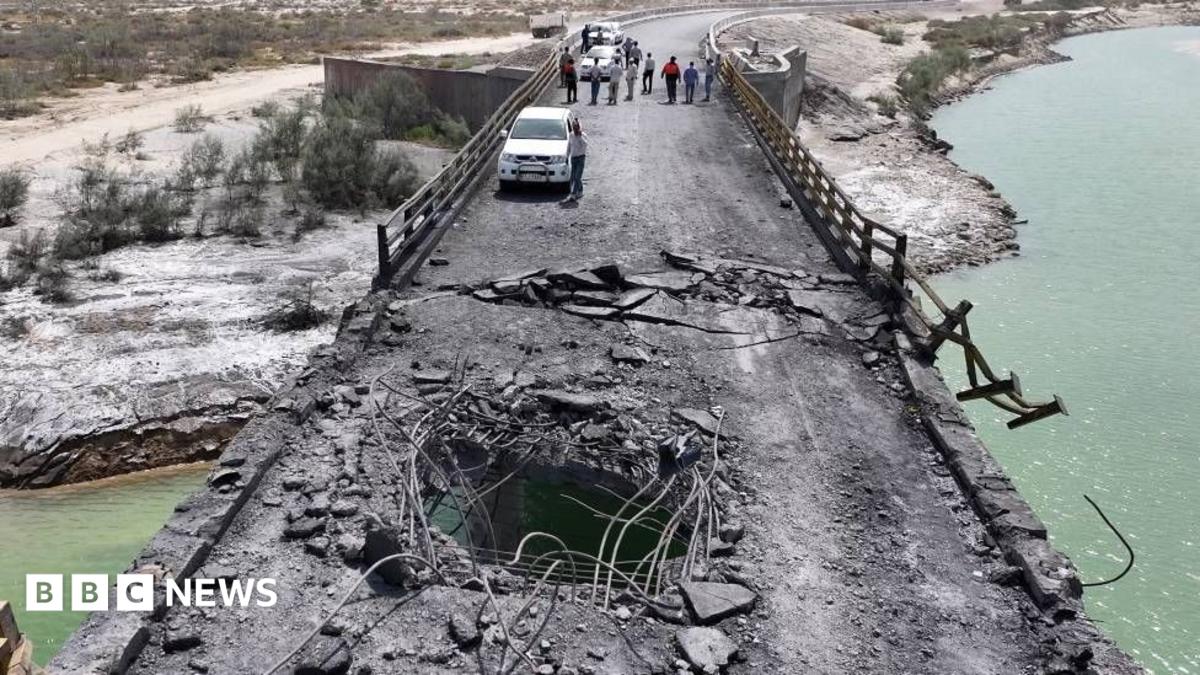
However, independent verification efforts have shed light on certain incidents. BBC Verify and BBC Persian collaborated to confirm extensive damage to the Gariveh Bridge in Iran’s southern Hormozgan province. Night-time footage depicted a colossal ball of flames engulfing the structure, while daylight images revealed a crumbled stretch of road and significant rubble surrounding the broken bridge. Provincial authorities later confirmed a tragic toll of seven fatalities from the attacks in the region. A White House spokesperson reiterated the US position, stating that US Iran strikes were carried out “exclusively on military targets, including military logistics infrastructure.” Furthermore, the US confirmed the destruction of a control tower at the port of Chabahar, with Defence Secretary Pete Hegseth sharing compelling imagery of the structure’s collapse, which Centcom identified as part of an IRGC maritime surveillance network.
Meanwhile, unconfirmed reports paint a grim picture for American personnel. Sources close to the BBC’s US partner CBS News indicate that multiple US service members sustained injuries during Iranian attacks on two Jordanian bases over the past week. Iran’s armed forces, for their part, asserted on Friday that they had attacked several US military facilities across Kuwait, Bahrain, Jordan, and, for the first time, Syria – claims the US has categorically denied.