Introduction: The Successful Conclusion of Artemis 2
After years of intense preparation and a breathtaking 10-day journey around the Moon, humanity has officially returned from deep space. On April 10, 2026, the world collectively held its breath as the Orion spacecraft re-entered Earth’s atmosphere. If you missed the live broadcast and are wondering about the exact artemis 2 splashdown time and how the final hours of the mission unfolded, you are in the right place.
This mission marks the very first crewed flight of the NASA-led Artemis program and the first time humans have traveled beyond low Earth orbit since the Apollo 17 mission in 1972. In this detailed update, we will break down the exact timeline of the splashdown, the intense reentry process, and what this monumental success means for the future of space exploration.
Read our complete guide on the Artemis 1 uncrewed test flight here!
Exact Artemis 2 Splashdown Time and Location
When dealing with orbital mechanics and traveling at speeds exceeding 24,000 miles per hour, timing is absolutely everything. A miscalculation of even a few seconds can drastically alter a spacecraft’s landing zone.
The Official Landing Details
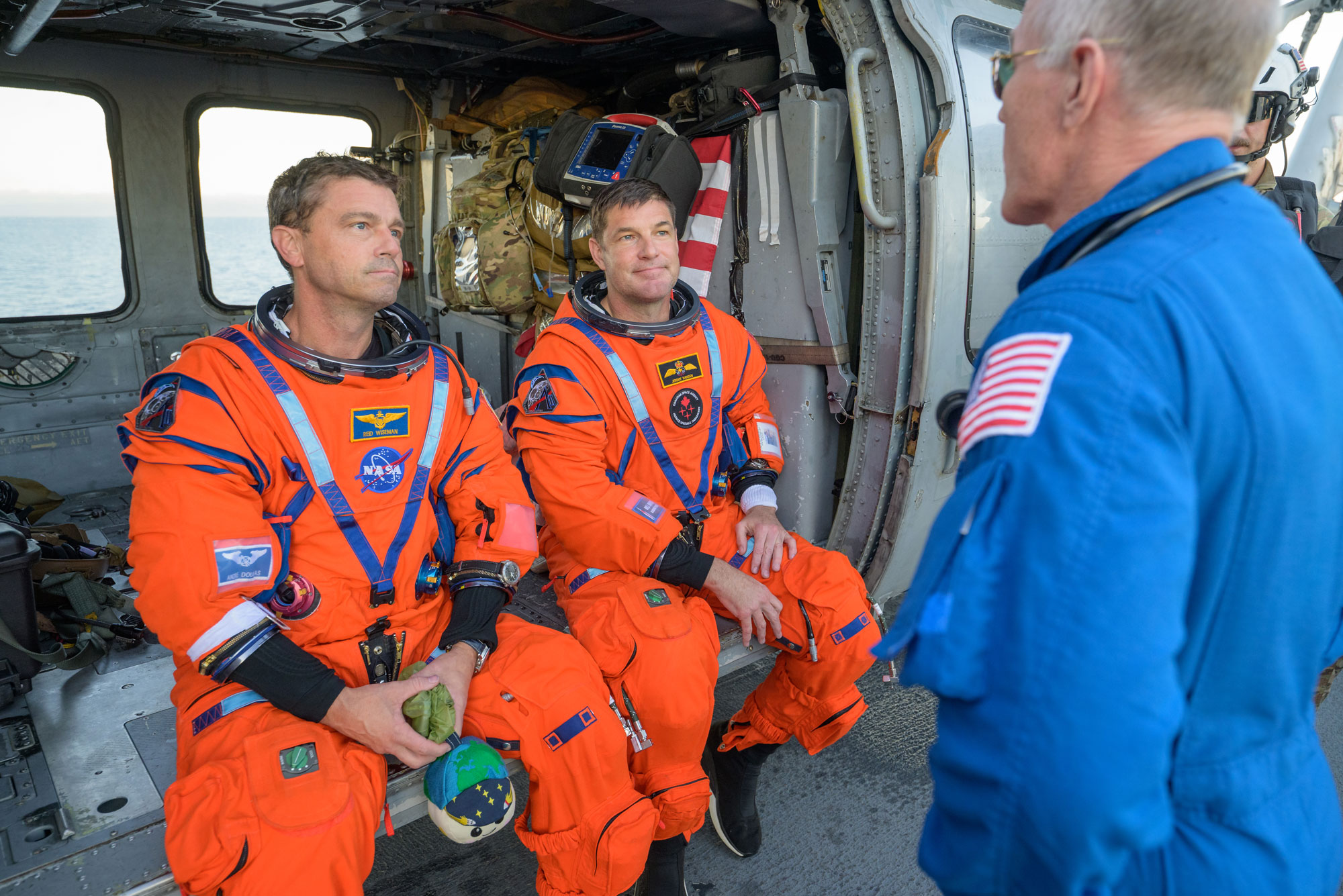
The official artemis 2 splashdown time occurred precisely at 8:07 p.m. EDT (5:07 p.m. PDT) on Friday, April 10, 2026. The Orion capsule, proudly named Integrity by its crew, made a picture-perfect landing in the Pacific Ocean off the coast of San Diego, California. Within minutes of hitting the water, recovery teams from NASA and the U.S. military, stationed aboard the USS John P. Murtha, moved in to secure the capsule and safely extract the astronauts.
The Intense 13 Minutes: Reentry and Splashdown Timeline
The journey from the Moon to the Earth’s surface is incredibly perilous. The final 13 minutes of the flight are often considered the most dangerous phase of the entire mission, subjecting the spacecraft and its crew to immense heat and extreme gravitational forces.
Surviving the Communications Blackout
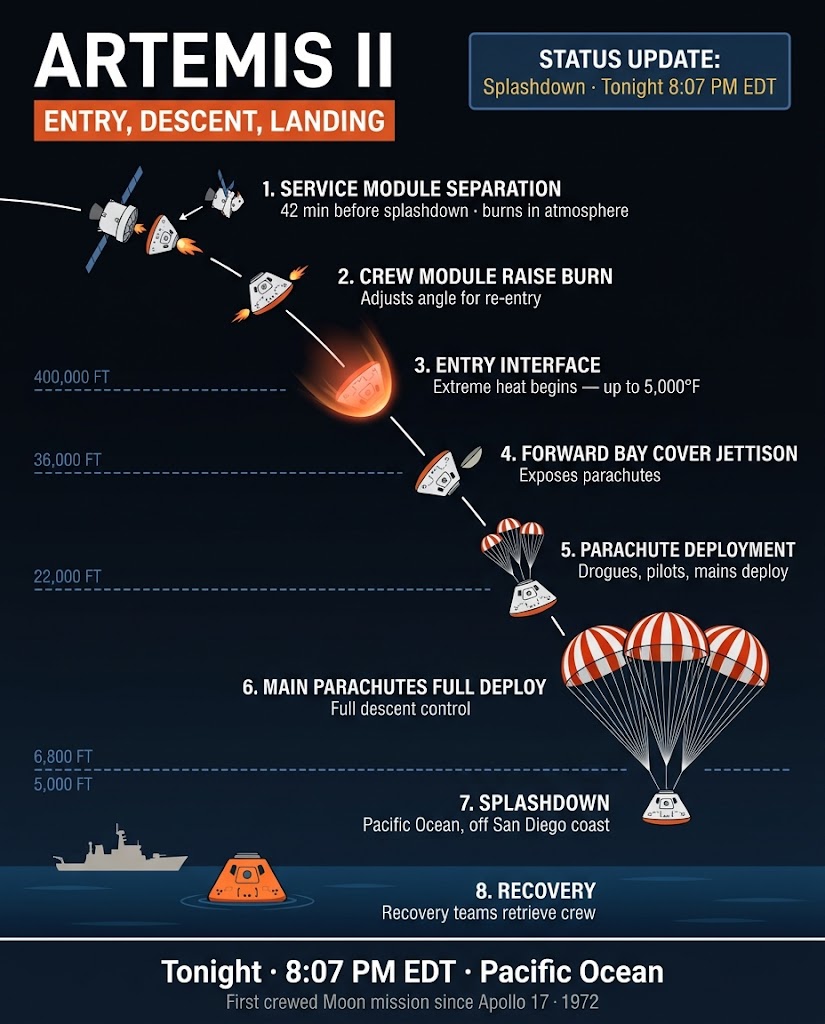
At exactly 7:53 p.m. EDT, the Orion capsule hit the Earth’s upper atmosphere, officially beginning the reentry interface. Because the spacecraft was traveling at nearly 35 times the speed of sound, the friction between the capsule’s heat shield and the atmosphere created a massive envelope of superheated plasma. This plasma completely blocks all radio signals. For six agonizing minutes, Mission Control in Houston completely lost contact with the crew. The spacecraft successfully endured temperatures exceeding 5,000 degrees Fahrenheit before communication was finally restored at 7:59 p.m. EDT.
Parachute Deployment and Final Descent
Once the capsule survived the intense heat of reentry, the next critical step was slowing it down to a survivable landing speed.
- 8:03 p.m. EDT: At an altitude of roughly 22,000 feet, two massive drogue parachutes deployed, stabilizing the capsule and rapidly decreasing its speed.
- 8:04 p.m. EDT: At 6,000 feet, the three main parachutes successfully unfurled. These massive canopies dramatically slowed the Orion capsule down to a gentle 20 miles per hour.
- 8:07 p.m. EDT: The spacecraft made contact with the Pacific Ocean, officially marking the exact artemis 2 splashdown time and the successful end of the mission.
Check out the official NASA blog for high-resolution photos of the recovery operations.
Who Was on Board the Historic Artemis 2 Mission?
The hardware and technology are incredibly impressive, but the true heart of this mission lies with the brave individuals who piloted the spacecraft.
A Diverse and Pioneering Crew
The Artemis 2 crew consisted of four highly trained astronauts who have now etched their names into the history books:
- Reid Wiseman (NASA): The Mission Commander, responsible for the overall safety and success of the flight.
- Victor Glover (NASA): The Pilot, making history as the first person of color to leave low Earth orbit.
- Christina Koch (NASA): Mission Specialist, officially the first woman to ever participate in a lunar mission.
- Jeremy Hansen (CSA): Mission Specialist from the Canadian Space Agency, making him the first non-American to travel to the Moon.
During their 10-day journey, this crew tested Orion’s life support systems, conducted complex manual piloting demonstrations, and captured breathtaking images of the Earth rising over the lunar far side.
What the Artemis 2 Success Means for the Future
With the successful splashdown of Artemis 2, the global space community is already looking ahead to the next massive milestone.
Paving the Way for Artemis 3
Because the crew safely returned and the Orion capsule performed flawlessly, NASA can now confidently proceed with Artemis 3. Currently targeted for next year, Artemis 3 will take the ultimate step: returning human boots to the lunar surface for the first time in over 50 years. The data collected during this recent splashdown will be heavily analyzed to ensure the safety of those future lunar walkers.
Conclusion: A Giant Leap for the 21st Century
The safe return of the Orion capsule and its crew is a monumental achievement for international space exploration. By hitting the exact target artemis 2 splashdown time and surviving the extreme conditions of deep-space reentry, NASA has proven that the technology required for long-term lunar exploration is finally ready.
About the Author