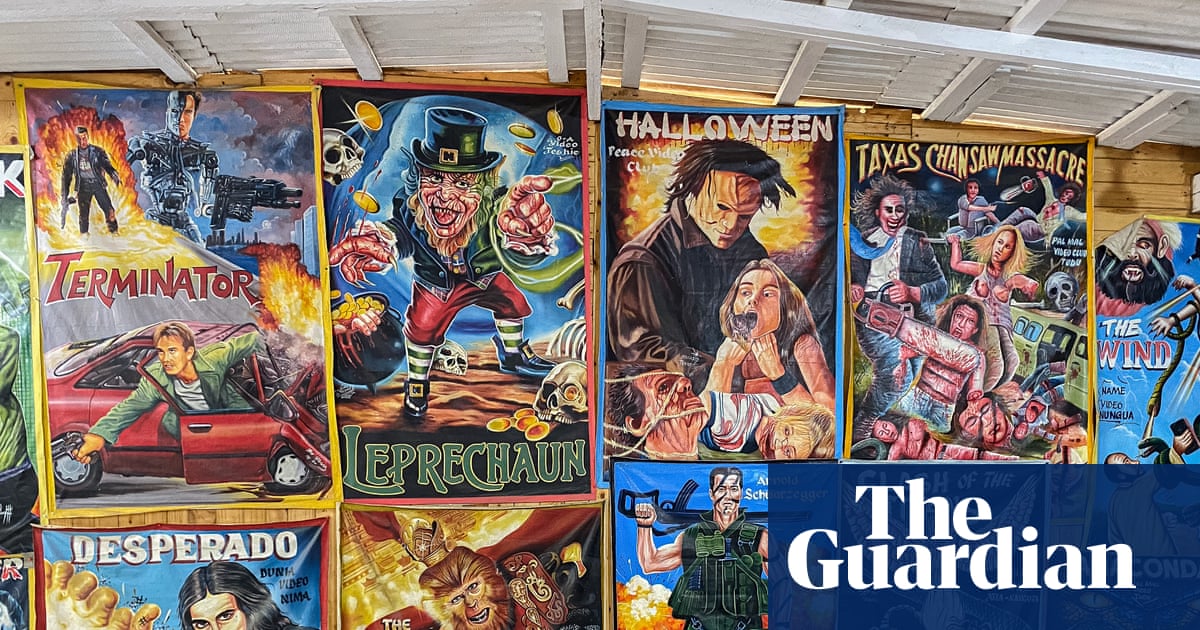
Imagine a world where Disney’s sweet The Little Mermaid gets a macabre makeover, complete with a bloodied knife and a menacing skull. Such audacious reinterpretations aren’t just artistic whims; they are the vibrant heartbeat of Ghanaian film posters, an utterly unique art form that thrived for decades and is now captivating global audiences anew.
In Teshie, near Accra, the artist known as Heavy J, whose real name is Jeaurs Affutu, meticulously adds crimson oil paint to a canvas made from a flour sack. He’s rendering a knife, dripping with blood, clutched by a figure—a surprisingly benign Prince Eric. Nearby, a skull begins to emerge, an ominous addition wholly unrelated to Ariel’s aquatic fairytale. “We add more to make people interested,” Heavy J explains, capturing the very essence of these startling creations.
From the late 1970s to the early 2000s, these hand-painted film posters were an indispensable part of Ghana’s burgeoning film culture. Local artists crafted these vibrant, often wildly inaccurate, advertisements for neighborhood video clubs, which found that original movie posters simply failed to draw a crowd. The artists, engaged in a playful yet fierce competition, aimed to create the most compelling “forgery,” transforming conventional plot lines into canvases for their surreal and humorous flights of fancy.
As the 21st century dawned, and with increased access to electricity and personal television sets, the demand for these posters waned, forcing many video clubs to close and painters to seek new livelihoods. Yet, the distinctiveness of these artworks had already captured international attention, earning a place in books and foreign exhibitions as highly prized collectibles. Today, thanks to the power of online marketing and a passionate Western customer base, there’s been a significant resurgence in demand for newly painted Ghanaian film posters.
The Art of Exaggeration: What Makes Ghanaian Film Posters So Compelling?
At the forefront of this revival is Deadly Prey Gallery, a business co-founded in 2012 by Ghanaian native Robert Kofi and Chicago video rental store owner Brian Chankin. Kofi, who once worked as a “hype man” for video centers in his youth, now serves as both manager and editor for a collective of 15 artists, including Heavy J. He curates commissions, guides artistic visions, and ensures the works reach enthusiastic online buyers, predominantly from the US. These distinctive pieces, often depicting old action, sci-fi, and horror films like The Exorcist or the Terminator franchise, command prices starting at $600.
The creative process is a dance between imagination and bold instruction. Take Stoger, born Benjamin Amartey, a former sculptor turned poster painter. Working on a poster for the experimental drama Gummo, he depicts three cats and a man eating spaghetti in a bathtub. Kofi’s feedback is blunt: the cats aren’t aggressive enough, the spaghetti too clean. “I want uglier cat scenes,” Kofi demands in Ga. “The spaghetti has to be dirtier.” This hands-on direction ensures the raw, untamed aesthetic persists.
Joseph Oduro-Frimpong, director of the Centre of African Popular Culture at Ashesi University and a collector himself, explains the philosophy behind this vibrant art form: an African tradition of “visualising the invisible.” Audiences, having not seen the films, couldn’t judge accuracy. Thus, artists engaged in “imaginative painting,” injecting sensational elements not present in the original narratives. This inherent sensationalism, while designed to attract, sometimes had dramatic consequences. Kofi vividly recalls a 1990s incident where viewers, feeling deceived by a poster’s depiction of a Jean-Claude Van Damme beheading that never occurred in Double Impact, physically attacked him!
Today, dozens of these mesmerizing works, from Jennifer Lopez battling a snake in Anaconda to a mouse emerging from Jamie Lee Curtis’s mouth in Halloween, adorn the wooden walls of the Centre for National Culture in Accra. It’s a testament to a thriving craft and a powerful cultural statement. “We are preserving a tradition,” Kofi asserts with pride. “We are preserving a history.” The extraordinary evolution of these diverse artistic traditions continues to captivate, ensuring the legacy of these imaginative artworks endures.
About the Author