
Germany’s Merz attacks AfD in stormy debate after far-right election win
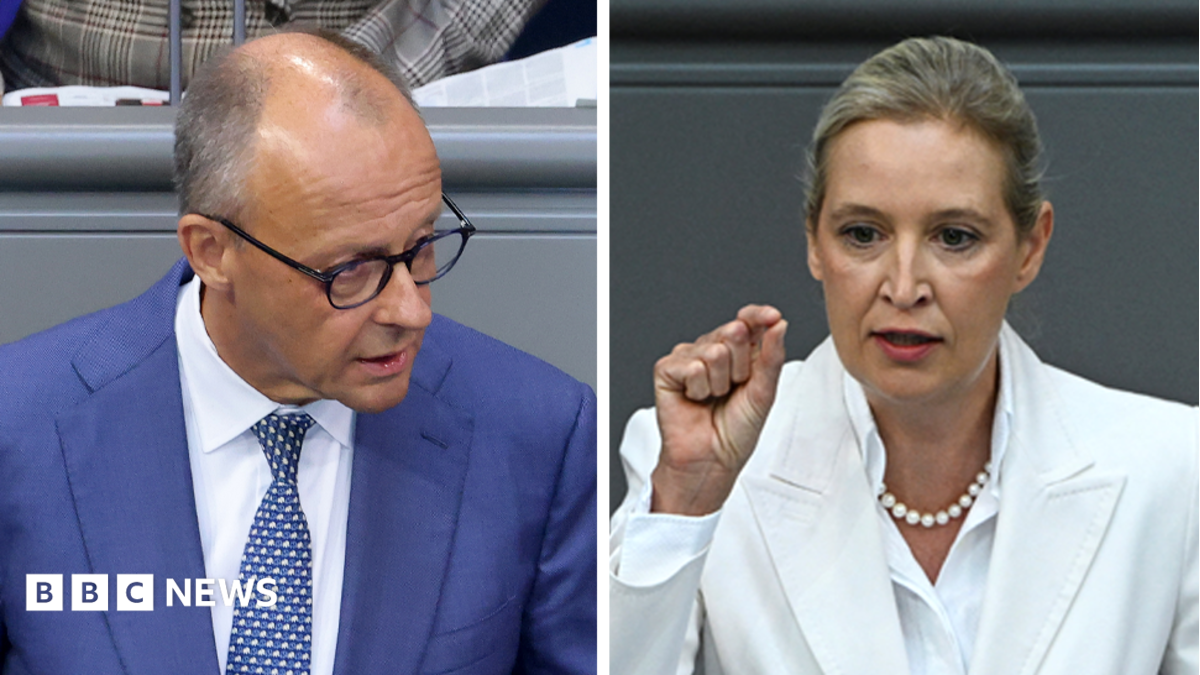
A political firestorm erupted in Germany’s Bundestag this week as Chancellor Friedrich Merz launched a scathing attack on the Alternative for Germany (AfD) leader Alice Weidel. This intensely acrimonious debate followed the far-right party’s seismic AfD election win in the eastern state of Saxony-Anhalt, a result that has undeniably sent shockwaves through the very foundations of German politics. Merz, visibly frustrated and resolute, denounced the AfD as a “destructive force” and controversially equated their proposed migration policy with “ethnic cleansing” for skilled workers, highlighting the profound ideological chasm now dominating the national discourse.
The clash, marking the first direct confrontation between Merz and Weidel since Sunday’s provincial triumph, was a spectacle of raw political tension. Addressing the hallowed halls of the Bundestag, Merz articulated deep concerns over the AfD’s sweeping gains, where they secured an astonishing nearly 44% of the vote. In stark contrast, his own conservative Christian Democrats (CDU) saw their support base dramatically halved, a testament to the shifting political landscape in a region still grappling with its post-reunification identity.
The Rising Tide of the AfD Election Win and its Implications
Weidel, unfazed by Merz’s condemnation, retorted with equal ferocity. She asserted that the electorate’s verdict in Saxony-Anhalt was a clear repudiation of Merz’s fragile coalition government, arguing that his alliance with the centre-left had demonstrably failed the German people. Her message was unequivocal: the current administration’s time, she implied, was unequivocally drawing to a close. However, Merz was swift to retaliate, accusing the AfD of actively undermining German interests through its perceived alignment with Russia, a stance that has become a significant point of contention on the international stage. He further warned that the party’s controversial “remigration” policy, a euphemism for the mass deportation of non-ethnic Germans, would affect millions of residents, regardless of their contributions to society.
The immediate political future of Saxony-Anhalt remains shrouded in uncertainty. Despite their monumental success, the AfD fell three seats short of an outright majority, creating a precarious path to forming a government. Historically, no far-right party has held power in any of Germany’s 16 states since the end of World War Two, making this AfD election win a truly unprecedented moment. Merz himself conceded that this “seismic” outcome has irrevocably altered the country’s political fabric.
Adding another layer of complexity to the situation, the AfD’s ascendancy has garnered international attention, notably from former US President Donald Trump. He publicly lauded the AfD’s performance, drawing parallels to his own populist narrative and linking their triumph to what he termed “absolutely horrible immigration rules and regulations.” This external validation further emboldens the party while simultaneously escalating the concerns of mainstream German politicians and international observers.
The ‘Ethnic Cleansing’ Allegation and the ‘Brandmauer’
The specific policies advocated by the AfD in Saxony-Anhalt have been classified as “right-wing extremist” by German domestic intelligence agencies. Their aggressive platform includes a commitment to a “deportation and remigration” offensive specifically targeting irregular migrants. During the heated parliamentary exchange, punctuated by frequent heckling from AfD MPs, Merz did not mince words. He starkly reminded Weidel that a significant portion – one in six – of Germany’s skilled workforce possesses a migration background. He contended that implementing the AfD’s policy would be tantamount to “nothing other than an ethnic cleansing in the skilled trades based on skin colour and origin,” a chilling accusation that resonated deeply within the chamber.
While acknowledging the necessity for some deportations, the chancellor stressed the government’s principled distinction between individuals who actively contribute to Germany’s economic prosperity and those without permanent residency rights. The escalating disruption from AfD MPs reached such a pitch that Bundestag President Julia Klöckner was compelled to intervene, admonishing the parliamentarians with a stern, “We are not on a football pitch,” a clear indication of the frayed nerves and heightened emotions permeating the debate.
Weidel, on her part, fiercely maintained that unchecked mass migration was directly responsible for a rise in daily knife violence and attacks on public transport and within train stations. Merz, however, countered this narrative by issuing a stark warning: the implementation of AfD’s proposed policies would cripple essential services, rendering care homes, hospitals, and restaurants utterly dysfunctional due to an acute shortage of labor. This economic argument is a crucial battleground in the ongoing political struggle, where the real-world consequences of policy proposals are scrutinized.
Beyond the immediate aftermath of the AfD election win, the debate also brought to the forefront the long-standing “Brandmauer” – or firewall – a crucial historical political consensus among mainstream German parties not to collaborate or form coalitions with the far-right. Weidel challenged this directly, citing the need for pragmatic governance. Meanwhile, Ulrich Siegmund, the AfD’s candidate for premier in Saxony-Anhalt, even floated the audacious idea of the CDU abandoning the Brandmauer to work with his party. This proposition underscores the profound challenge the AfD’s growing influence poses to Germany’s post-war political order, especially as Europe grapples with a spiralling campaign of sabotage and geopolitical uncertainty.
The recent election result is more than just a local victory; it signifies a pivotal moment for Germany. It forces a national introspection on identity, immigration, and economic stability, pushing traditional parties to re-evaluate their strategies in an increasingly fragmented political landscape. The storm that raged in the Bundestag is merely a prelude to the complex and challenging chapters yet to unfold in German democracy.