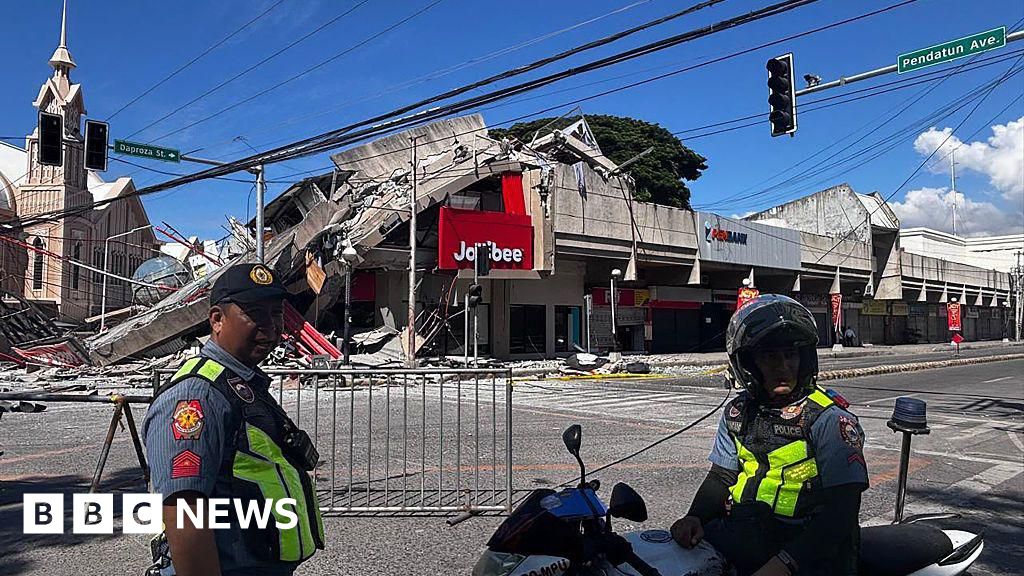
Southern Philippines reeling from immense devastation! A colossal magnitude-7.8 Mindanao earthquake has struck off the coast of Mindanao island, leaving a trail of destruction and at least 19 confirmed fatalities. The earth’s terrifying tremor, which hit Monday at 07:37 local time, ignited widespread panic and triggered tsunami alerts across the Pacific, impacting nations from Japan to Australia, though many were later rescinded.
The sheer power of the quake was evident in shocking videos and images rapidly circulating. Buildings, once standing proud, lay in crumbled heaps. Most notably, a popular Jollibee fast food restaurant in the southern region was reduced to utter rubble, a stark symbol of the destructive force unleashed. Initial reports indicate at least 134 individuals sustained injuries across provinces like South Cotabato, Sultan Kudarat, Sarangani, and the bustling city of General Santos. These figures, however, are preliminary, awaiting comprehensive verification from the National Disaster Risk Reduction and Management Council.
Immediate Response to the Mindanao Earthquake
President Ferdinand Marcos Jr. swiftly issued a statement, assuring the nation that government agencies are fully coordinating a robust disaster response. “The national government is moving and we will not leave Mindanao behind,” he pledged, emphasizing immediate aid and support. Crucially, in a move impacting thousands, classes in affected areas were suspended, a decision coinciding with the first day of the school year. Imagine the terror: dozens of primary school students in Davao Occidental province were captured on video, squatting on the violently shaking ground, a corrugated-roof shelter collapsing menacingly behind them. Thankfully, the school later confirmed no injuries among the terrified children.
The initial jolt was just the beginning. Over 130 aftershocks, ranging from minor tremors of 1.3 to powerful jolts of 6.7 magnitude, have rattled the region in the aftermath. Power and communication networks in coastal Sarangani province buckled under the stress, though diligent efforts saw them restored in due course. General Santos, the vibrant “tuna capital” and hometown of boxing legend Manny Pacquiao, found itself perilously close to the epicenter of this seismic event.
The Philippines, unfortunately, is no stranger to such cataclysms. Situated on the volatile “Ring of Fire,” a horseshoe-shaped belt of volcanoes and seismic activity, earthquakes are a regular occurrence. While many pass with minimal impact, some, like this devastating Mindanao earthquake, prove deadly. Just last September, a magnitude-6.9 quake in the central Visayas region tragically claimed over 70 lives. These geological forces are a constant reminder of the planet’s dynamic nature.
International warnings quickly followed the main tremor. Japanese authorities initially cautioned residents of one-meter-tall tsunami waves. Later, smaller waves, a few centimeters in Okinawa and a 20cm (0.7ft) surge in the distant Ogasawara Islands, were indeed observed. Waves of varying heights, up to 1.4m (4.6ft), were also detected along the coastlines of Indonesia, Palau, and other parts of the Philippines. For more information on global seismic events, one can refer to data from the United States Geological Survey.
About the Author