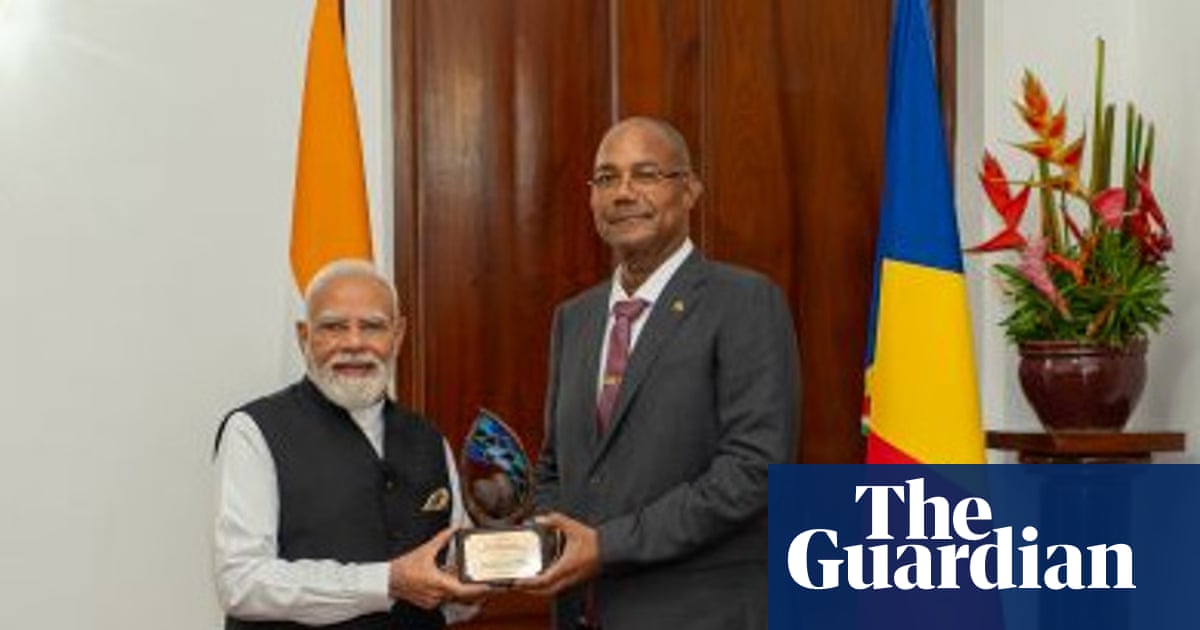
The Indian Prime Minister, Narendra Modi, has once again found himself at the epicenter of a swirling international discussion, sparking a significant Modi awards controversy. His recent visit to the serene archipelago of Seychelles, where he was presented with the “Guardian of the Blue Horizon” award, has ignited a firestorm of questions, with critics scrutinizing the legitimacy and circumstances surrounding the accolade.
Allegations Fuel the Modi Awards Controversy
Upon receiving the award from Seychelles President Patrick Herminie, complete with a trophy and certificate, what initially appeared to be a celebratory moment swiftly devolved into public ridicule. Observers quickly pointed out glaring errors: the certificate egregiously misspelled “republic” and even the host nation itself, “Seycheeles.” More astonishingly, it emerged the “honor” was established merely three days prior to Modi’s arrival, making him its inaugural – and thus far, sole – recipient. Adding to the brouhaha, analysis software reportedly flagged the certificate as AI-generated, further deepening the skepticism.
The opposition Congress party seized on the gaffe, their politician Supriya Shrinate quipping on social media, “Give him any award, and he’ll come running.” This pointed criticism underscored the haste and perceived impropriety surrounding the presentation. Modi’s Bharatiya Janata Party (BJP), however, swiftly counter-attacked, proclaiming the award a “proud moment for India” and a testament to his “green leadership.” The Seychelles foreign ministry later attempted damage control, asserting the initial document was merely a “working draft” and that an “authentic and duly approved” version had since been issued, vehemently defending the distinction’s genuineness.
Yet, this incident is hardly an isolated one. Over his dozen years in power, Mr. Modi has cultivated a remarkable penchant for accumulating awards, both domestically and during his numerous foreign excursions. Only last month, ahead of his visit to Israel, its parliament seemingly fast-tracked the creation of the Knesset medal – a supposed “highest honor” – which, again, he was the first and only to receive upon landing. Similarly, in 2019, he became the inaugural recipient of India’s Philip Kotler presidential award, an honour touted for annual bestowal to a national leader; its website now lies dormant, with no subsequent recipients ever named.
Indeed, privately, there’s an unspoken understanding that such accolades have become an expected fixture of the Indian Prime Minister’s international itinerary. Nilanjan Mukhopadhyay, a biographer of Modi, argues that this global pursuit of prizes is profoundly symptomatic of the Prime Minister’s personality-driven politics. The goal, he suggests, is clear: to broadcast to his fervent supporters, and to potential converts alike, that Mr. Modi’s unparalleled greatness is being recognized worldwide, and that India’s growing international influence is directly attributable to his singular persona. This recurring Modi awards controversy continues to fuel debate over the nature of global diplomacy and political self-promotion. In the past year alone, Modi has also become the first foreign head of state to receive Ethiopia’s Great Honour Nishan and the order of the Republic of Trinidad & Tobago, further underscoring this pattern.
About the Author