
NCERT Revises Class 8 History Textbook, Says ‘Congress Widely Opposed Partition’
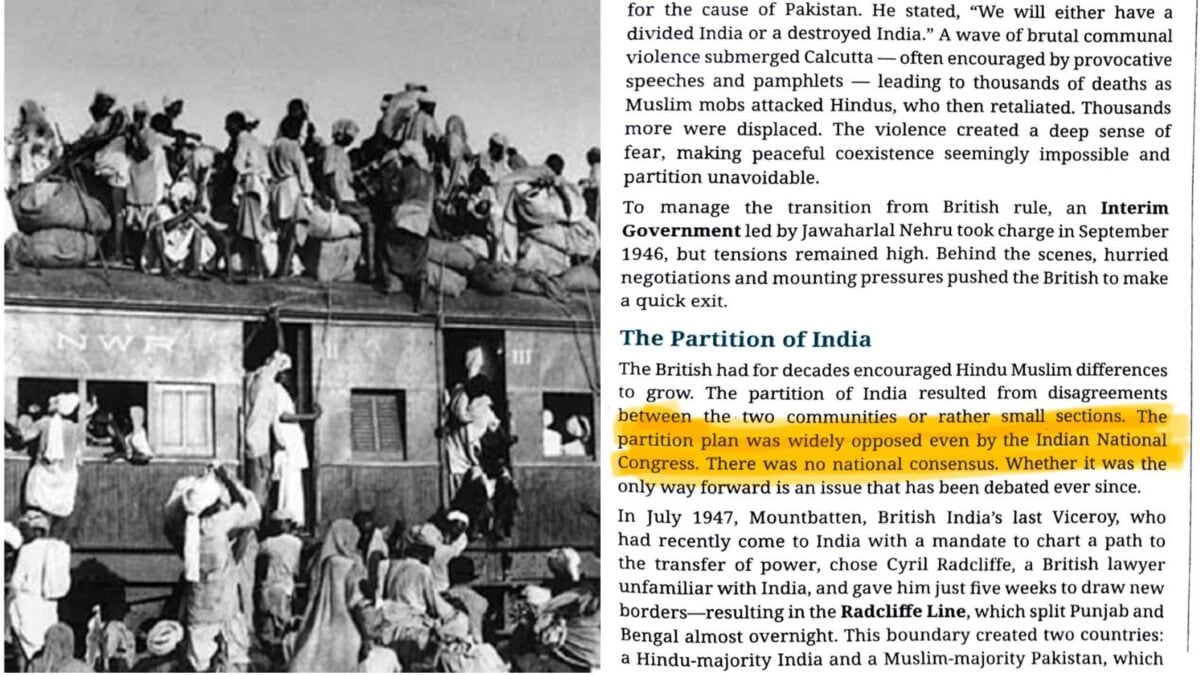
The National Council of Educational Research and Training (NCERT) has initiated a significant NCERT textbook revision for its Class 8 Social Science curriculum, specifically altering the historical narrative surrounding India’s Partition. This update introduces crucial changes to the portrayal of the Indian National Congress’s role, stirring fresh academic and public discourse.
The newly edited chapter, titled “India’s Long Road to Independence,” replaces an earlier version previously withdrawn following observations by the Supreme Court. This iteration aims to offer a more nuanced understanding of the tumultuous period. A key alteration emphasizes that the British administration had, for decades, actively “encouraged Hindu-Muslim differences to grow,” attributing the Partition’s tragic genesis to disagreements “between the two communities or rather small sections” instead of a broader societal breakdown.
Challenging the Narrative: NCERT Textbook Revision Details
Perhaps the most striking change is the assertion that the Partition plan “was widely opposed even by the Indian National Congress.” This contrasts sharply with previous versions. Furthermore, the revised text now omits a sentence that once described “the Congress leaders were helpless” amidst the horrific communal violence that engulfed the subcontinent. While Mahatma Gandhi’s deep anguish over the bloodshed remains, the explicit mention of leadership’s helplessness has been removed, subtly shifting the historical lens. The chapter thoughtfully frames the Congress leadership’s ultimate decision to accept Partition as an ongoing historical debate, questioning whether it was indeed “the only way forward.” This encourages students to critically engage with past choices and their complex repercussions.
Historian Christhu Doss from JNU aptly states that “history is an unending dialogue between past and present, shaped not only by events but also by interpretations.” He advocates for a holistic approach, urging students to grasp both the Congress party’s initial resistance and its eventual, reluctant acceptance of Partition, considering the multi-faceted complexities of the era. This comprehensive view, he argues, helps students transcend simplistic narratives and fosters critical reflection, providing a richer understanding of one of the most significant events in modern Indian history. The ongoing NCERT textbook revision promises to keep the conversation vibrant regarding how historical events are presented to young minds in schools nationwide.