
Six months into the Iran war, a new Gulf security architecture is emerging
Six months after the conflict with Iran dramatically intensified, a profound re-evaluation of Gulf regional dynamics has taken hold. What was once a relatively predictable security landscape, heavily reliant on a singular external guarantor, is now giving way to an intricate, multi-layered defense architecture. The ongoing hostilities have not only altered strategic calculations but have fundamentally reshaped how Gulf states perceive their vulnerabilities, define their partnerships, and approach collective defense. This seismic shift underscores a growing imperative for self-reliance and diversified alliances, even as the indispensable role of the United States continues to be acknowledged.
The initial premise, largely built upon Washington’s formidable security umbrella, bilateral defense agreements with Western powers, and the somewhat uneven framework of the Gulf Cooperation Council (GCC), has proven insufficient against the evolving threat matrix. The June 2025 missile strike on Al Udeid Air Base in Qatar served as a chilling, unequivocal demonstration of the region’s susceptibility. Cities, vital energy infrastructure, bustling airports, critical ports, and indispensable shipping lanes are all acutely vulnerable to the insidious proliferation of missiles, sophisticated drones, and other disruptive technologies. Threats that once resided comfortably within the theoretical realms of war games and strategic planning documents have abruptly become immediate, visceral operational realities.
The Shifting Sands of Gulf Security
While the bedrock of US engagement remains crucial, the past half-year has clarified an undeniable truth: the traditional security apparatus, by itself, simply isn’t enough. Gulf states are now actively constructing a more robust, layered security system. This involves not only fortifying cooperation amongst themselves but also assiduously cultivating deeper relationships with a broader spectrum of international partners. Turkey, for instance, has emerged as an increasingly pivotal player, while European states are demonstrating a burgeoning potential to contribute operationally. Existing bilateral military relationships are being pushed to deliver more tangible outcomes, simultaneously giving rise to novel regional arrangements that stand alongside and complement older structures.
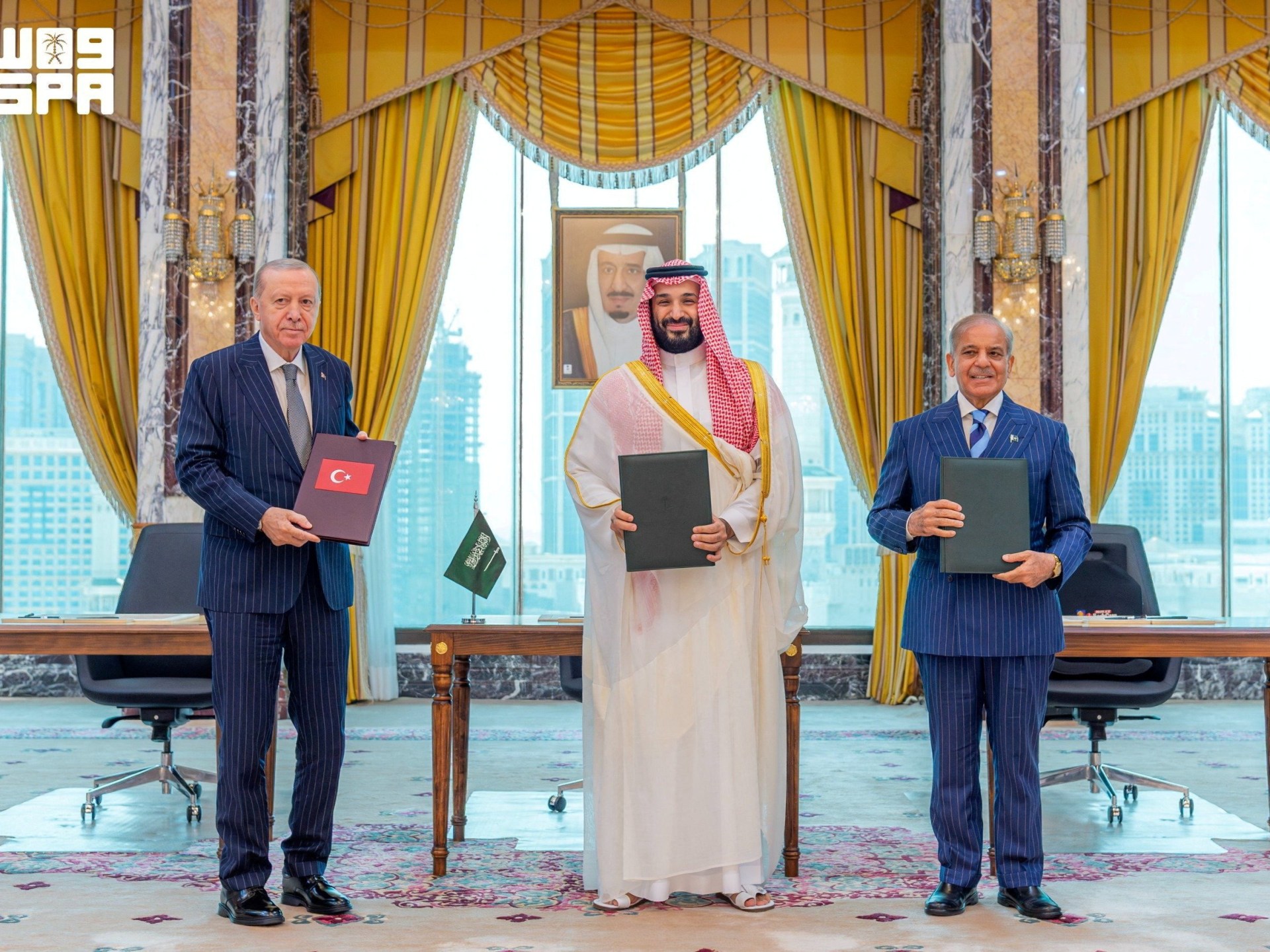
A prime example of this transformative phase is the Mecca Joint Defence Agreement, inked between Saudi Arabia, Turkey, and Pakistan. Its emphatic declaration that an armed attack on one signatory would be unequivocally treated as an attack on all immediately drew comparisons to the North Atlantic Treaty Organization. While the principle of collective defense is not entirely novel to the region – the GCC’s own Joint Defence Agreement contains a similar commitment, frequently reaffirmed during the present conflict – what sets the Mecca accord apart is its audacious extension of this collective-defense logic beyond the traditional confines of the GCC, forging a strategic link between Saudi Arabia, Turkey, and Pakistan.
Overlapping Partnerships: A Pragmatic Approach to Defense
The inclination to liken this to NATO, while understandable, risks obscuring the nuanced reality unfolding in the Gulf. The region is not poised to replicate NATO’s structure, nor is the wider Middle East inherently suited to a monolithic security alliance characterized by a singular hierarchy and an undifferentiated understanding of threat. Here, a threat might emanate from a state actor one day, and a non-state entity the next. Nations that share common ground on one particular threat might diverge dramatically on others. Crucially, no single regional state, however formidable its capabilities, is likely to be universally accepted as the permanent political and military vanguard of every conceivable coalition.
What appears to be coalescing instead is an ingenious system of overlapping partnerships, a tapestry of cooperation rather than one grand, all-encompassing alliance. Different countries will align and collaborate against specific threats, their objectives and modalities of engagement fluid and adaptable. Some arrangements will naturally be Gulf-led, while others will seamlessly integrate broader regional or Western partners. Such a system necessitates a radically different conceptualization of leadership. Any regional security architecture predicated upon a rigid, permanent hierarchy will inevitably encounter resistance from states fiercely protective of their sovereignty and possessing vastly diverse capabilities.
Consequently, leadership must follow the threat. The nation confronting the immediate peril should logically wield the primary political voice in articulating the objectives of the response, defining acceptable levels of escalation, and authorizing the use of its sovereign territory. Yet, operational leadership need not rigidly mirror this political hierarchy. A maritime crisis, for instance, might be most effectively managed by the partner possessing the preeminent naval capabilities. Conversely, an intricate air defense scenario might necessitate the active leadership of a partner with the most relevant and advanced air defense systems. These discussions about diverse regional partnerships often involve complex diplomatic efforts, similar to how Russia and Syria engage in military base negotiations, highlighting the varied forms of security cooperation.
Interoperability: The Cornerstone of Effective Collaboration
This inherent flexibility, while perhaps the most realistic foundation for deeper security cooperation, critically hinges on the capacity of these disparate, overlapping relationships to seamlessly connect and function when exigencies demand. This is precisely where the concept of interoperability ascends to paramount importance. If several nations commit to mutual support during a crisis, the fundamental question arises: can they actually execute that promise? Can they facilitate rapid information sharing, ensure unimpeded communication across their respective militaries, coordinate complex decisions efficiently, and establish clear lines of authority and responsibility well in advance?
An attack on one country does not automatically mandate an identical response from every partner. Support can manifest in myriad forms: critical intelligence sharing, robust air defense contributions, essential logistics, maritime protection, or, in the gravest circumstances, direct military engagement. The clearer these mutual expectations are delineated before a crisis erupts, the more credible and potent the collective commitment becomes when it is truly put to the test. Practical examples already exist; Qatar’s military relationship with Britain has transcended the conventional buyer-seller paradigm. British and Qatari personnel have trained and operated advanced Typhoon aircraft together through a joint squadron. This relationship was robustly tested in March when an RAF Typhoon, operating within this joint squadron, successfully intercepted and shot down an Iranian attack drone aimed at Qatar. Such collaboration underscores the growing emphasis on truly operational partnerships.
Europe’s Expanding Role and Future Challenges for Gulf Security
Europe, too, is poised to assume a more significant operational role, not as a replacement for Washington, but as a vital complement. The United States will likely retain its mantle as the Gulf’s preeminent security partner, yet Gulf states are judiciously cultivating deeper operational ties with capable partners like Britain, France, and Turkey. The past six months have emphatically reinforced the rationale for this diversification. Gulf and European militaries increasingly confront a shared lexicon of operational challenges: sophisticated missiles, ubiquitous drones, persistent maritime insecurity, insidious electronic warfare, and critical threats to infrastructure. Therefore, the future trajectory of Gulf-European defense relations should be gauged less by the sheer volume of contracts signed, and more by the verifiable capacity of their forces to genuinely work in concert when circumstances demand.
This necessitates a concerted commitment to more joint exercises, the judicious embedding of personnel, and meticulously coordinated planning. Furthermore, it requires the establishment of flexible arrangements that enable bilateral partnerships to effectively interface with broader GCC and regional structures. The Mecca agreement, ambitious in its scope, will ultimately face this same acid test. Turkey’s defense ministry has publicly articulated plans for heightened political and military coordination, joint exercises, advanced air-defense cooperation, and deeper defense-industrial ties among the three signatories. However, for the moment, these remain aspirations rather than concrete manifestations of operational integration. The agreement’s ultimate efficacy will hinge on whether Saudi, Turkish, and Pakistani forces can cultivate enduring habits of cooperation: whether they can reliably share intelligence, synchronize air defense efforts, sustain prolonged joint operations, and leverage defense-industrial collaboration to resolve practical military challenges.
Six months into the Iran war, the contours of a distinctly different Gulf security architecture are unequivocally taking shape. It is highly improbable that this emerging system will be defined by a single alliance, a solitary leader, or a monolithic understanding of the myriad threats. Crucially, the Gulf is neither abandoning the United States nor systematically dismantling the deeply entrenched security relationships that have served it for decades. Instead, a more agile and adaptive system is coalescing around these existing frameworks: bolstered intra-Gulf cooperation, the strategic inclusion of additional regional partnerships, significantly deeper operational links with capable European militaries, and an overarching, intensified emphasis on the fundamental question of whether countries can truly operate together. While some of this momentum might inevitably wane if the immediate threat recedes, the enduring challenge is to ingrain the lessons of these tumultuous six months into the very fabric of regional defense. The ultimate test remains elegantly simple: when the next missile is launched, the next drone transgresses a border, or the next vital shipping lane is imperiled, can the nations involved collectively perceive the danger, make unified decisions, and respond in concert? If they can, then the most profound legacy of this war may not be merely another treaty or a new alliance, but rather the genesis of a Gulf security system that is inherently more connected, more flexible, and, crucially, far better equipped to protect the dynamic region it is intended to serve.