
Sonia Gandhi’s ‘Belonging’ Released: Memoir Or Political Rewriting Of History? | THE RIGHT STAND
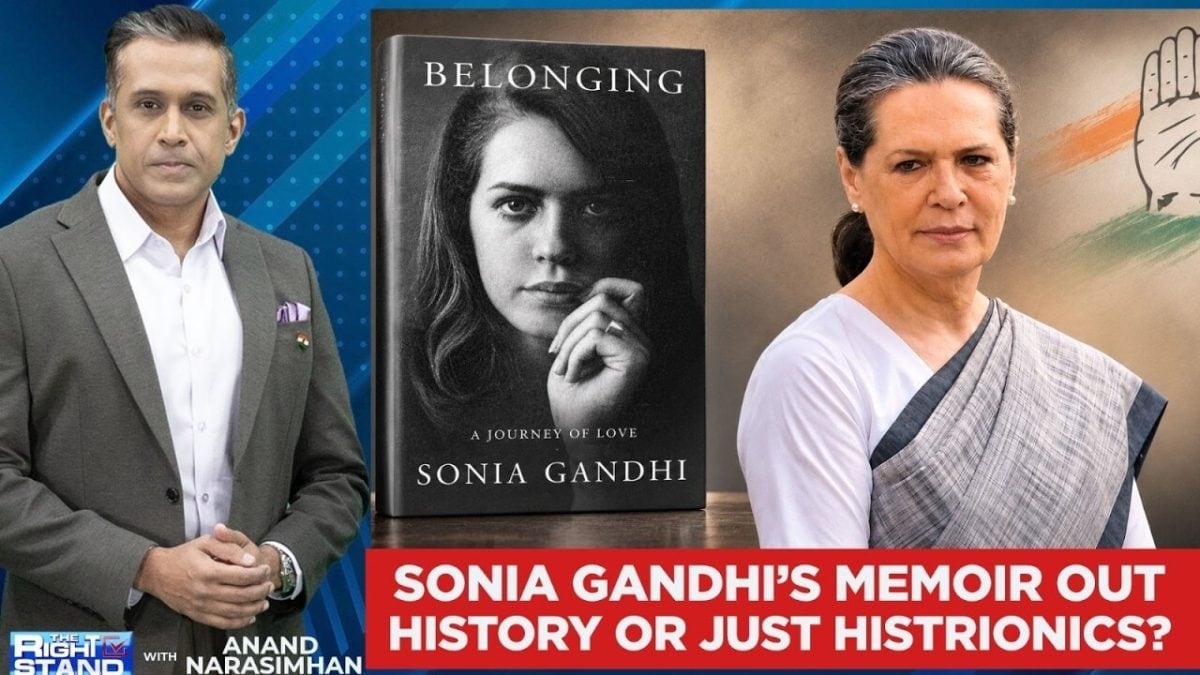
Introduction & Key Takeaways
The release of Sonia Gandhi’s memoir, Belonging: A Journey of Love, has ignited a fierce national conversation regarding the historical narrative of the Nehru-Gandhi dynasty. As a pivotal figure in Indian politics, Gandhi’s personal account provides a rare glimpse into the inner workings of a family that has defined modern India for decades. However, the publication has also drawn intense scrutiny from political opponents, raising questions about whether the text serves as a sincere reflection of life or a strategic attempt to reframe the legacy of the Congress party. This Sonia Gandhi memoir represents a critical juncture in the ongoing battle for historical hegemony in Indian public discourse.
Key Takeaways from the Release:
- The 544-page book details her early life in Italy, her integration into the Nehru-Gandhi household, and the profound trauma of losing both her mother-in-law and husband to political assassinations.
- The memoir provides a personal explanation for her famous 2004 decision to decline the prime ministerial office.
- Political rivals, particularly the BJP, argue that the book glosses over controversial periods, including the 1984 anti-Sikh riots, leading to charges of historical revisionism.
- The text has reignited the debate over dynastic politics versus meritocracy in the Indian electoral framework.
Background & Context
To understand the gravity of this release, one must appreciate the sheer influence of the Nehru-Gandhi family on the trajectory of India. Sonia Gandhi served as the President of the Indian National Congress for nearly two decades, a tenure characterized by the party’s rise to power in 2004 and its subsequent electoral challenges. Her transition from an Italian-born outsider to the most powerful political actor in India was often marked by intense scrutiny. For more context on how political narratives are contested, one might explore the Sonia Gandhi’s Memoir ‘Belonging’ Under Fire: BJP Targets Her Over 1984 Riots report, which highlights the specific friction points between her account and historical critiques.
Root Cause & Deep Dive Analysis
Why does a memoir trigger such profound polarization in the Indian political landscape? The answer lies in the concept of memory as a political asset. By documenting her personal experience of the 1984 riots or the internal power dynamics of the Congress leadership, Gandhi seeks to solidify a specific version of events. Critics, however, contend that the Sonia Gandhi memoir omits crucial perspectives or simplifies complex failures. In the study of political history, it is common for leaders to utilize memoirs to soften or justify past decisions. The inherent conflict here is not just about the accuracy of facts, but about whose version of history gains legitimacy in the national consciousness.
Strategic Implications & Future Impact
The release is not merely a literary event but a tactical move within the broader arena of 2026 Indian politics. By humanizing herself through the lens of loss and maternal duty, Gandhi aims to shield her legacy from the persistent attacks of her opposition. Yet, the BJP remains adamant that the memoir is an incomplete picture. As political parties prepare for future electoral cycles, the narrative control exerted by this book will play a role in shaping how the younger, post-liberalization generation perceives the legacy of the Congress party. The Sonia Gandhi memoir effectively forces the opposition to engage with the past on her terms, while simultaneously inviting them to aggressively dismantle her claims.
Conclusion & What to Watch Next
As the initial fervor surrounding the book settles, the long-term impact will be measured by how deep the skepticism of her critics penetrates the public mind. Future debates will likely focus on whether this text will be treated as an authoritative historical document or as a partisan pamphlet. Observers should keep a close watch on how the Congress party uses this memoir to build a new communication strategy in the face of dwindling electoral influence. The struggle for the narrative of modern India is far from over, and memoirs like these are merely the latest battleground in that protracted conflict.